Tafenoquine Stories: Dave & Alison – A Tragic Update

Featured

David John Whitfield

16 June 1972 – 27 February 2024

Courtesy: Alison Whitfield

Alison Whitfield has sent me numerous messages over the last four and a half years, but last weekend was the first time I found myself just staring at the words trying to comprehend exactly it was that I was reading. It didn’t make any sense to me, it just couldn’t be. She told me that Dave had lost his battle, and even though I knew what that meant, I didn’t want to believe it. She would later tell me that she thought that she would always be there to stop him as she had been so many times before. In thinking about it, I suppose I had always taken that for granted myself. It would only serve to prove that you can’t take anything for granted when it comes to the living nightmare that is tafenoquine and everything it brings with it.

Car found upside down in a river after crashing off Running Creek bridge in Queensland’s southwest

https://7news.com.au/news/car-found-upside-down-in-a-river-after-crashing-off-running-creek-bridge-in-queenslands-southwest-c-13747415

Veteran Dave Whitfield tragically takes his own life after pleading for help

https://www.dailytelegraph.com.au/news/national/veteran-dave-whitfield-tragically-takes-his-own-life-after-pleading-for-help/news-story/7ac06cb05298763495542f556840b54e

I was granted access to his medical records from his last visit to the hospital before he died, and this is what I have been able to put together.

Sometime on the evening of Monday the 26th, Dave had driven himself to the Emergency Department at the Casino and District Memorial Hospital in Casino, NSW, about a three-hour drive from home in Brisbane, presenting “very agitated and elevated.” According to the report, he was a veteran, suffered from PTSD and chronic pain and “blames an army mefloquine trial for much of his health and mental problems.” It also notes that he takes olanzapine (Zyprexa), which is an atypical antipsychotic, as needed for agitation, in addition to 30mg of MScontin and diazepam (Valium) regularly. He had also apparently run out of these prescriptions two days before this visit.

He stated that he had become agitated after losing his phone at the train station in Casino following a concert, having a complete meltdown after going home and then coming back to Casino to look for the phone without success. In fact, the concert was in Port MacQuarrie, about a four-hour drive south of Casino, and he hadn’t lost the phone but rather had destroyed it. He subsequently got a new phone but left it at his mother’s house before driving to Casino.

He made no mention of the fact that their beloved little companion, Ivy, had been put down four days prior. Alison used to breed the Pomeranian-Cavalier King Charles Spaniel cross and Ivy was born not breathing. She was able to resuscitate the puppy, and Ivy went on to thrive, even though things weren’t looking good for her at the beginning. Alison told me that she felt that losing Ivy precipitated Dave’s most recent difficulties, in addition to a dispute with the DVA over a claim that should have been settled last year.

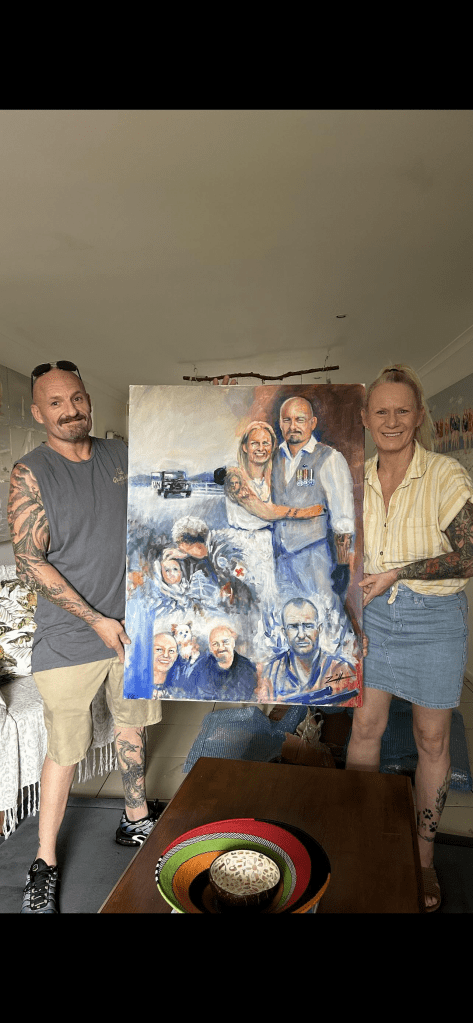
These portraits were painted by the award-winning Australian traditional realist, Joe Zapp. Courtesy: Alison Whitfield
Courtesy: Alison Whitfield

Having asked for something to calm him down and help him sleep, the doctor ordered droperidol (Inapsine). Again they didn’t indicate the dosage or the route of administration in the record though it was likely an intramuscular injection. Primarily used to treat nausea and vomiting it is also used as a sedative and antipsychotic, and is in the same family as haloperidol which is commonly used to sedate patients who are in psychosis.

In the morning he was reported to be much calmer and denied any suicidality, stating that he had come to the ED to be sedated. Before being discharged he was given 10mg of Targin, which is a 2:1 formulation of oxycodone and naloxone, as well as 5mg of diazepam (Valium). Common side effects of both drugs include drowsiness.

(B) Targin®, a 2:1 combination of opioid agonist antagonist has been shown to be effective for ameliorating opioid induced constipation via the binding of naloxone to the μ‐opioid receptors in the GI tract and dislodging the oxycodone from the receptor. As a result, the adverse effects opioids on the GI tract are reversed, while the analgesic effects of oxycodone remain intact due to naloxone’s low bioavailability and first pass metabolism by the liver.

https://www.ncbi.nlm.nih.gov/pmc/articles/PMC10014000/#:~:text=(B)%20Targin%C2%AE%2C%20a,the%20oxycodone%20from%20the%20receptor.

The discharge report was signed off at 7:31am, with no record that he had been seen by anyone from the mental health service. According to the police who notified Alison of Dave’s death, the first reports of the accident came in at 8:50, less than 90 minutes later. This is roughly the same amount of time it would take to drive between Casino Memorial Hospital and the location where the accident took place.

An unethical trial, producing fraudulent results.

The drug trial that Dave told the doctors about was actually for tafenoquine (Arakoda), another type of anti-malarial that was shown in the results of small animal testing to be even more neurotoxic than mefloquine (Lariam). He was one of some 3,000 Australian troops who were deployed to Bougainville and East Timor on a peacekeeping mission, who would also be coerced into participating in a drug trial that lacked any sort of informed consent, thus rendering the trial unethical.

In addition to this none of the adverse psychological events experienced by any of the subjects who were given tafenoquine were reported in the study provided to the FDA, resulting in its approval and constituting a fraud by omission.

https://onecalgaryvoter.com/2019/08/11/an-advocate-equalizer-international-exclusive-australian-defense-forces-brass-engineer-cover-up-of-a-drug-trial-that-tested-a-controversial-anti-malarial/

Two weeks beforehand he and Alison had pleaded for help from the Royal Commission into Veteran Suicide, with Dave fronting the Brisbane hearing after meeting with the commissioners, hopeful that he would finally get the help he had been asking for for 20 years. Unsurprisingly, this would get him nowhere closer to getting what he desperately needed. They had even managed to get a sit-down at her kitchen table with Minister for Veterans Affairs Matt Keogh, who appeared to be listening intently to their plight. By this point, Alison had spent three months exhausting every avenue to get him extended inpatient treatment in a hospital, all to no avail and now the promises of help that they were getting were turning out to be nothing but more bullshit.

Earlier this week she received a condolence call from Peggy Brown, who sits as one of the Royal Commissioners that are tasked to “..listen, investigate and recommend actions or changes to address systemic issues contributing to suicide and suicidal behaviours by serving and ex-serving Defence members. What the Commissioners can and are required to investigate is set out in the terms of reference.” Alison’s reply was to tell the Commissioner that she held her and the other Commissioners partly responsible for Dave’s death. I can’t say that I disagree with her, as I have had issues with the Commission from the beginning. I will delve into more details at a later date, but I will say that these issues are related to both the make-up and the Terms of Reference of the Commission.

As for Minister Keogh, Alison says that she hasn’t received a call from him, despite the fact that he sat in her kitchen and saw how bad of a state Dave was in, and stated that it only showed what kind of a “weak prick” he is. She also assigns him some blame for her husband’s far too early passing.

Courtesy: Alison Whitfield

Right now Alison has a lot of questions that need answering, as do I, and once I have taken the time to grieve this loss I will begin looking for those answers. Several emails are going to be written, as I assure her that she isn’t alone in this daunting battle against the government. As in the case against David McBride, this is yet another example of how the Diggers pay the price while senior ADF commanders and politicians can act however they want without consequence. To them, I say that their time is coming.

Funeral

Dave’s funeral service will be held at the Hemmant Crematorium on Thursday, March 14th, 2024 at 2PM (AEDT) 0400 Zulu. The address is 500 Hemmant Tingalpa Road, Hemmant, QLD, 4147. Telephone 07 3403 8888.

It is being live-streamed and can be seen by clicking the link below and entering PIN 5292.

https://streaming.naoca.com.au/e/abf548b6-1501-4a0b-a9f2-fd37a58f016f

Godspeed soldier, your duty is done. Rest easy brother, now that you have at last found peace.

Canadian Veteran Walks the Talk

Retired Combat Engineer Chance Burles continues to lead through his actions.

The next time you go to the grocery store, head over to the produce department first and find a 20lb bag of potatoes, which you will carry in a backpack while you continue shopping, making sure to hit every aisle on the way to the cashier. How many would be able to make it to the cash register?

Now imagine carrying that bag of potatoes around on your back while embarking on a hike of 100 miles over four days. Next month, 40,000 competitors will gather in the Netherlands to participate in an event known as the “Walk of the World”, and some of those participants will attempt to do just that. Better known by many globally as the “Nijmegen March”, people will challenge the course and themselves in the 106th rendition of what the Dutch call “The 4 Days”.

https://www.4daagse.nl/en

Chance Encounter (Yes the pun is intentional).

I became aware of Chance Burles about five years ago through a mutual friend, Pat Stogran, who hosted a podcast about his views on leadership called “Leaderology”. One of the leadership principles Pat believes in is that successful leaders do so by their example, which resonated with me. Chance was a guest one night and it was obvious that he was one of the leaders in the veteran’s community. He was challenging other veterans to get up and move around, challenging them to do as he did and challenge themselves physically and mentally.

The Sherwood Park March. June 20th-23rd.

Chance accepted a challenge to do the Nijmegen March, and began training last November. Family commitments and current financial realities mean he won’t be able to participate in the Netherlands but, he will be marching at home in Sherwood Park, getting routes approximating those in the event and abiding by its rules. He will be doing it from June 20th to the 23rd, and chose to participate in the event open to active servicemen which involves a 40KM route while carrying a minimum of 10kg. Once again he is challenging his brethren to challenge themselves, and he’s seeing how many will answer.

The March in Fish Creek Park.

He got me walking in the Walk for Veterans every September since 2019, and he has once again inspired me to challenge myself. I will be attempting a march of 50 miles over the four days of the event from July 16th to the 19th in Fish Creek Provincial Park which is just a stone’s throw away from me. Because of my lower back issues, I will be playing things by ear as to whether or not I will be doing it carrying a pack.

https://albertaparks.ca/parks/kananaskis/fish-creek-pp/

In the meantime, I have my walking shoes ready to go and I’ll be training to get myself ready to go on July 16th. I’ll share my journey with you from training to the four days of the event while going over some of the facts and history of The 4 Days, and talking with Chance Burles about doing the march and challenging others to improve themselves and realize some personal growth. So go to his page on Facebook and give him some encouragement.

Chimo!

Everyone, Meet Sam.

An update to the story I published on June 7th.

I wrote about the need to recognize our aging veterans a couple of weeks ago, and one of those veterans was a Navy man called Sam whom I had the distinct pleasure of meeting. He served in Korea, and I was eager to get to know a little bit about him and hear a story or two, but it just wasn’t the time at that moment.

Last night I was reading Skyline, the bi-monthly magazine published by volunteers from Royal Canadian Legion Branch #285 (Centennial), my home branch. On page 9 I saw a picture of Sam accompanying a splendidly written story by my comrade Jane Steckley, part of the RCL#285 Veterans’ Legacy Project. Click the link below to read the story of Korean War veteran and my Legion comrade William T McIvor, better known as Sam.

https://drive.google.com/file/d/1ln_cj1oXAvOkXrslhAcGpZRCJD0hPqee/view?usp=sharing

Small Town Histories & Attractions: Torrington, Alberta

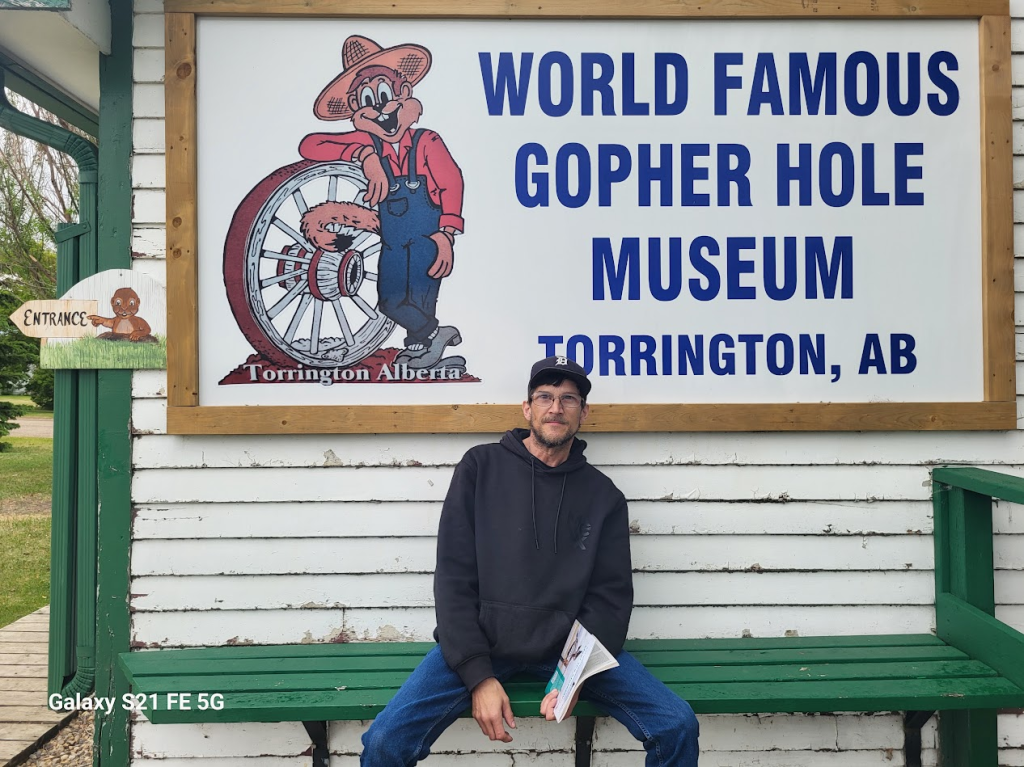
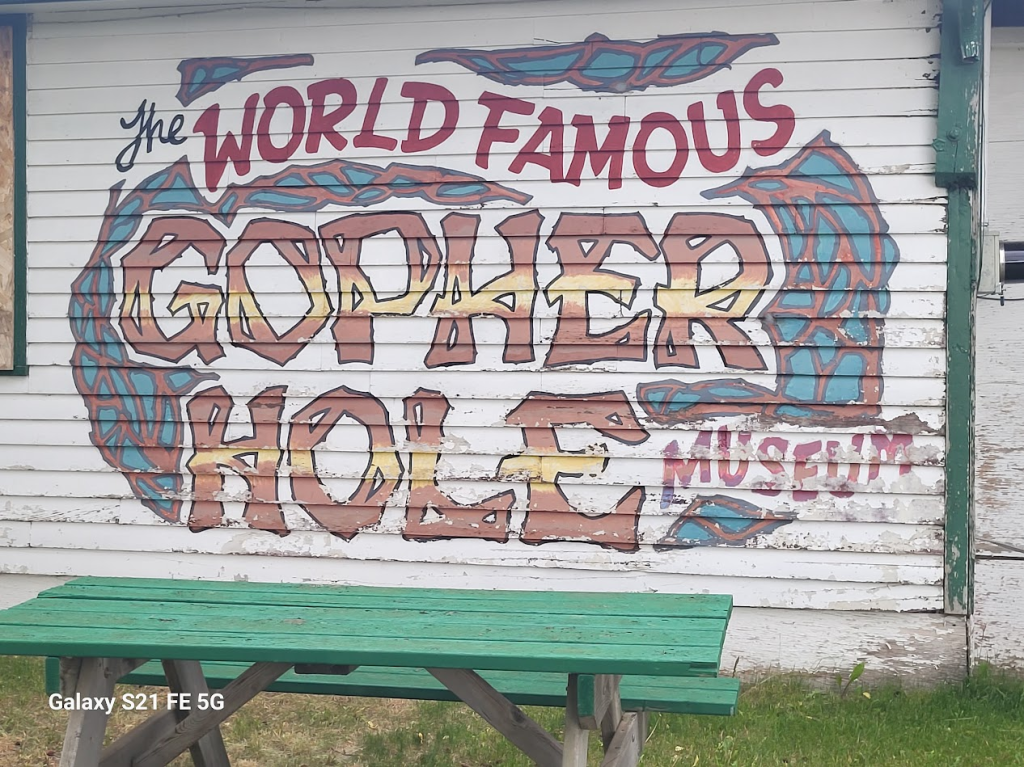
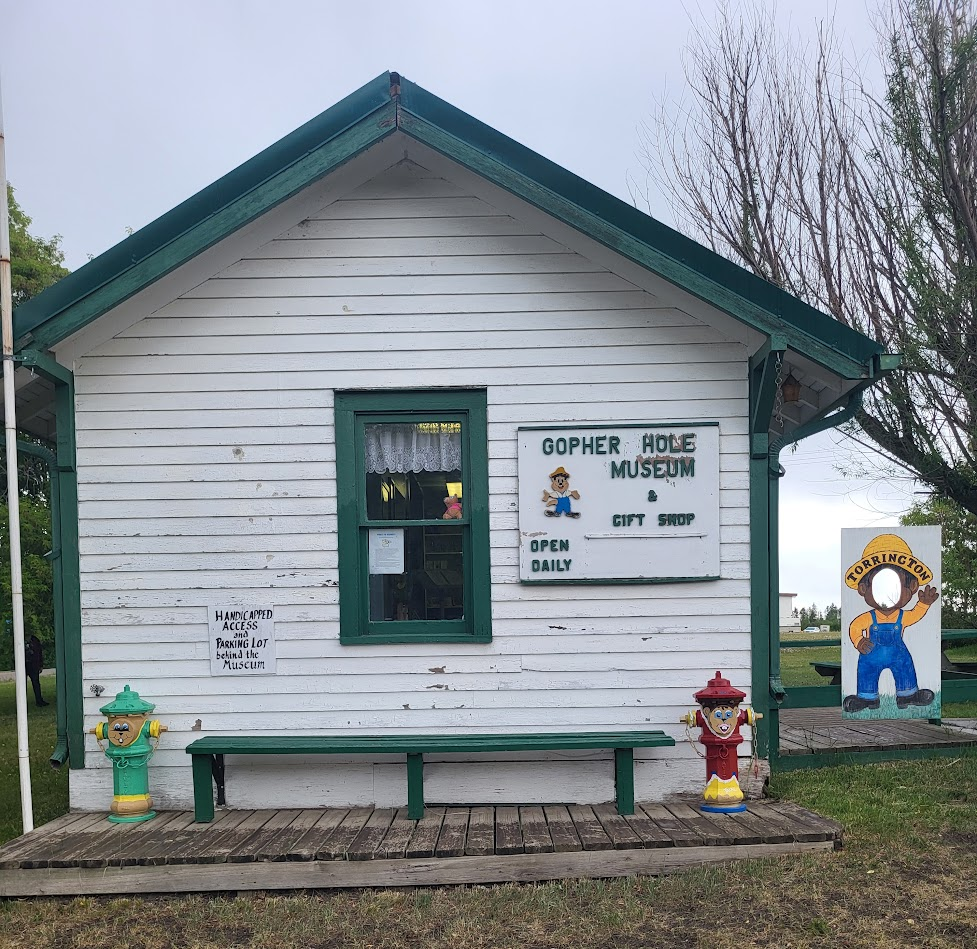
The World Famous Gopher Hole Museum & Gift Shop.

Needing a brief escape from the city, an old friend was doing a bit of a road trip on Saturday and invited me along for some company. The initial plan was to visit another friend of ours in Medicine Hat but, she was working, so we headed out apparently with no particular place to go until I was told about “plan b”, which involved retrieving some personal items from a place in Torrington, which is about 160km (99 miles) to the north-east of Calgary. I had never been before, so it would be another place to add to the list of places I’ve been.

The Menace and the Mascot.

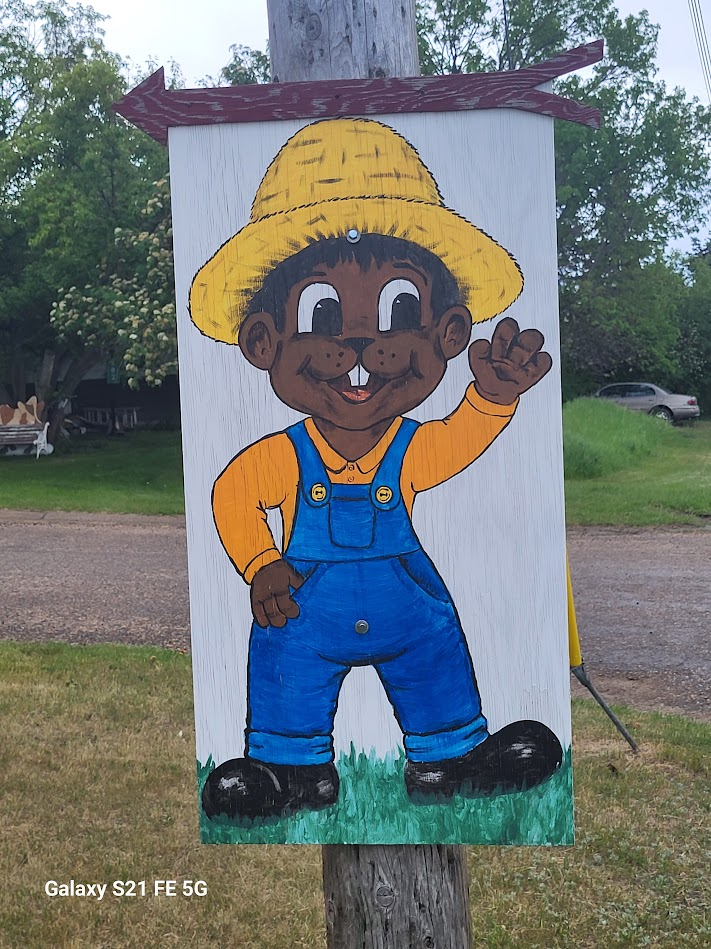
Here on the prairies the ubiquitous Richardson’s Ground Squirrel, better known as the gopher, is a rodent that is a menace to some and at the same time a mascot to others. Ranchers and farmers have lost livestock to broken legs resulting from stepping in a gopher hole, and they will work to eradicate the rodents using any means at their disposal. Many an enterprising teenaged boy would use a .22 caliber rifle to hunt gophers for local farmers and ranchers offering a bounty on gopher tails. Modern methods employ the pumping of propane or natural gas into their underground tunnels and then igniting it. Gophers are also known to be carriers of yersenia pestis, better known as the bacteria that causes the bubonic plague, so Alberta can be rat-free as much as we want, we’re still at risk for the disease that originally gave rats a bad name.

These same ranchers and farmers could very well be fans of the CFLs Saskatchewan Roughriders, whose team mascot ironically is a gopher named Gainer (which sounds much better than Ricky the Richardson’s Ground Squirrel), while fans of NCAA football and basketball are also likely to be at least somewhat familiar with the University of Minnesota Golden Gophers.

What About Gophers?

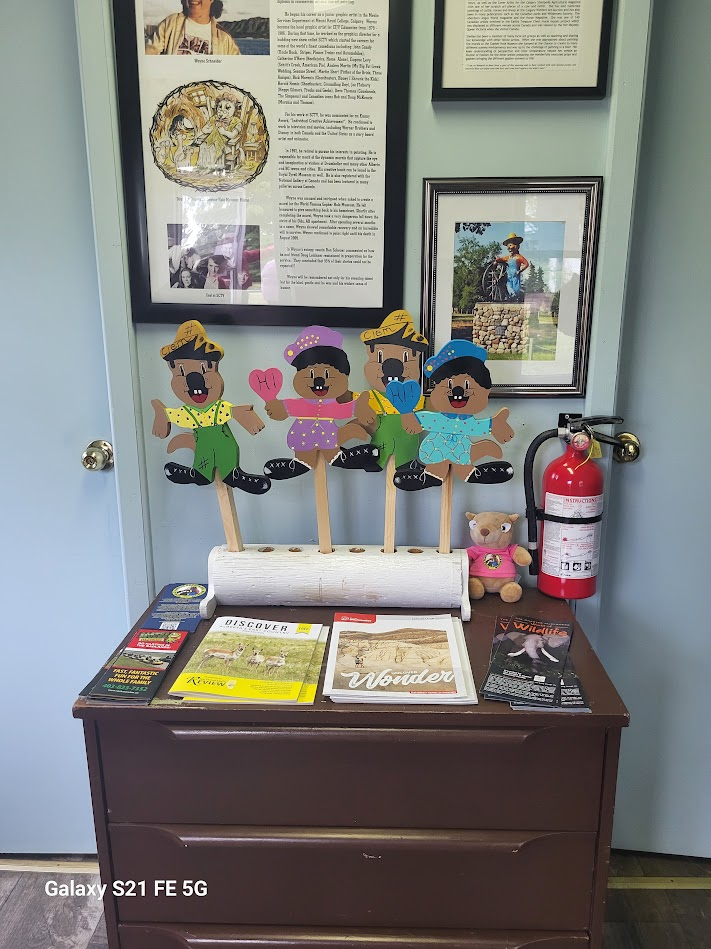
According to the legend it was back in the mid-1990s when some local volunteers began to think of a way to drum up tourism in their quaint, yet out of the way little hamlet. After a lady offered gophers as a solution, the co-founder and village mayor Otto Kurta thought it was just crazy enough to work, for two or three years maybe. In 2021, the World Famous Gopher Hole Museum celebrated its 25th anniversary, and there’s no sign of things slowing down.

Also the Local Abandoned Cat & Kitten Drop-off.

I was also informed by my guide that this location was known to be where people could drop off unwanted cats or kittens in the hopes that someone would give them a good home. There was a friendly Maine Coon greeting visitors by rubbing against their legs and offering up a meow that seemed to say “welcome”.

The museum is open daily, and quite reliably, between 10am and 5pm during the summer months. I say this because the local watering hole in the hotel is kind of hit and miss as to when it opens, so it’s always best to check ahead.

Improving and Expanding.

So successful has the museum been that it is looking to expand.

Colourful Visitors Map.

Every tourist attraction you visit has a map of the world on the wall covered in pins from all the various places around the globe visitors have come from. This of course naturally raises the question of whether or not anyone actually travelled 10,000 miles with the express purpose of visiting the Gopher Museum? We may never truly know the answer to this question but I would like to think at least one person has.

Gift Shop.

Immediately upon entering the museum you are in the gift shop, which has the standard gift shop fare. I myself would recommend the classic “So and so went to the World Famous Gopher Hole Museum and all I got was this crappy shirt”. I figure you can never go wrong with that.

The Exhibit Hall.

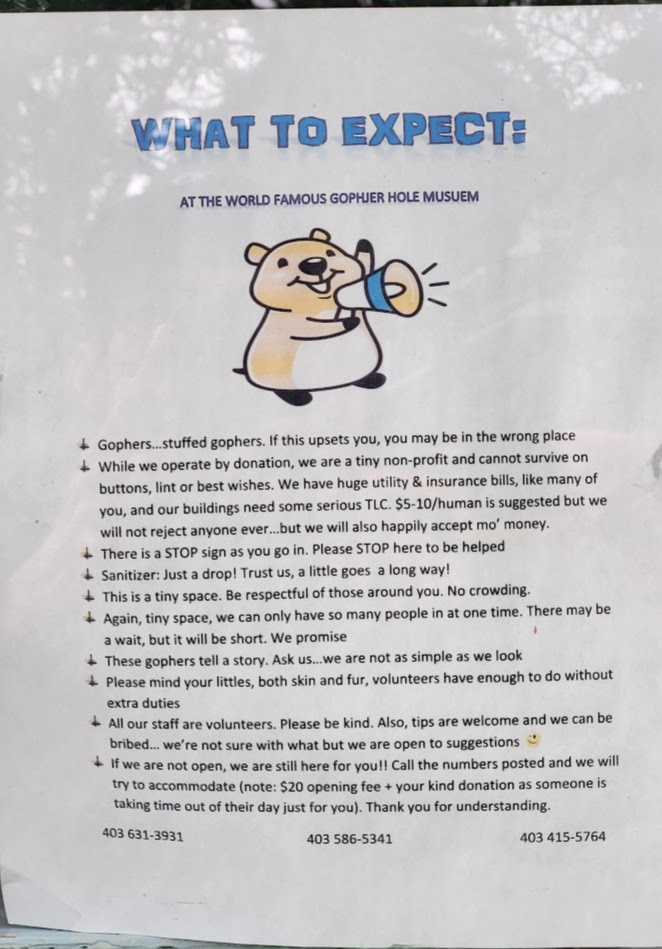
If you choose to enter the “Exhibit Hall” know that the risk of contracting the plague is beyond extremely low, as these gophers would have been deemed “flea free” from the time of taxidermy.

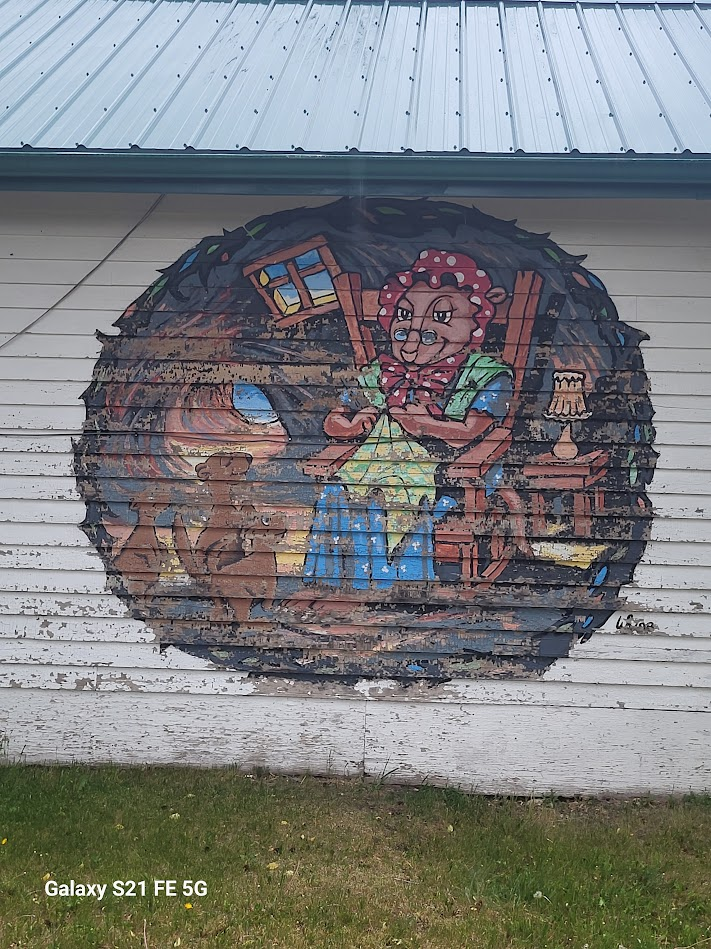
To be honest I really didn’t know what the hell to expect. I mean a gopher hole is just a hole in the ground, and if you’ve seen one you’ve seen the millions upon millions of others. What the curators of this museum are offering us is a glimpse down the gopher hole, using the town as a backdrop for a unique diorama.

Enjoy.

Torrington Hotel.

Fortunately for us the hotel bar was open during our visit and I can say that the artist did a great job on capturing how the place really looks.

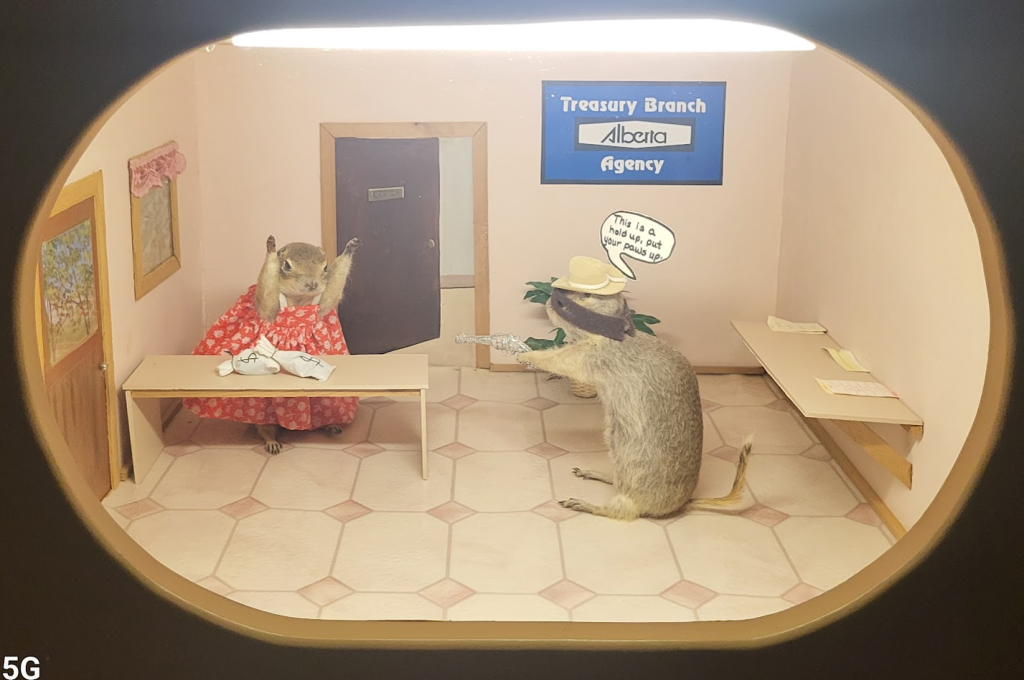
Torrington Treasury Branch.

All gun control will do is put the guns in the paws of the criminal critter element.

“This is a holdup. Put your paws up.”

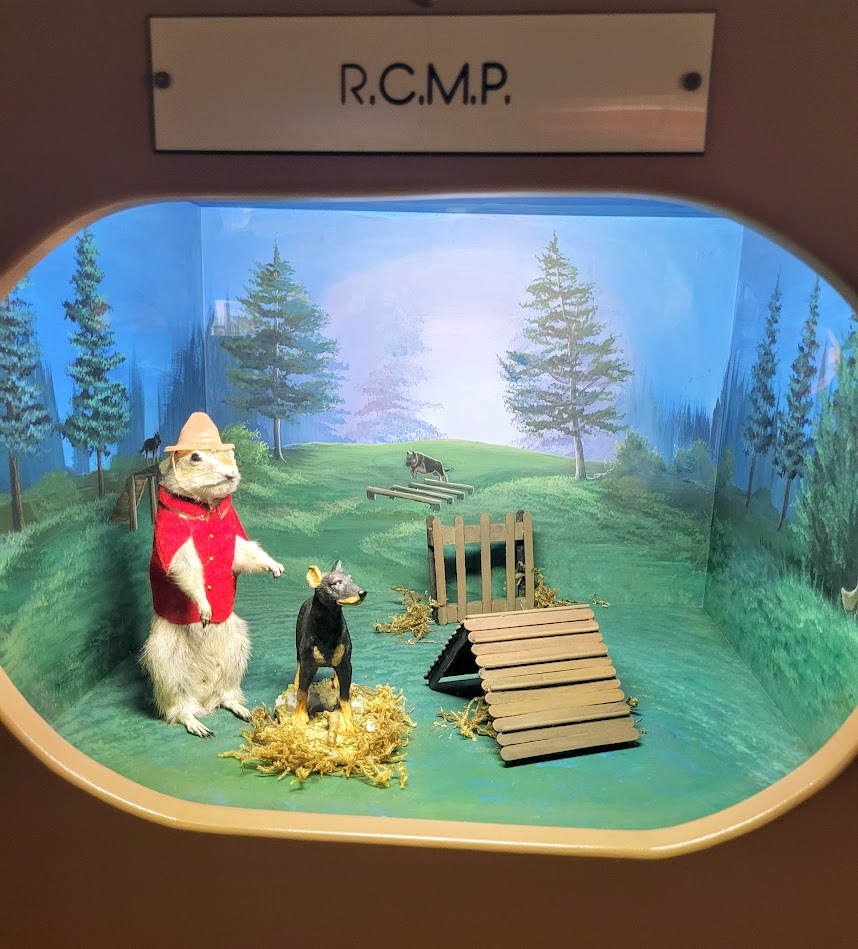
Olds RCMP Detachment.

Meanwhile 35km away at the Olds RCMP detachment….

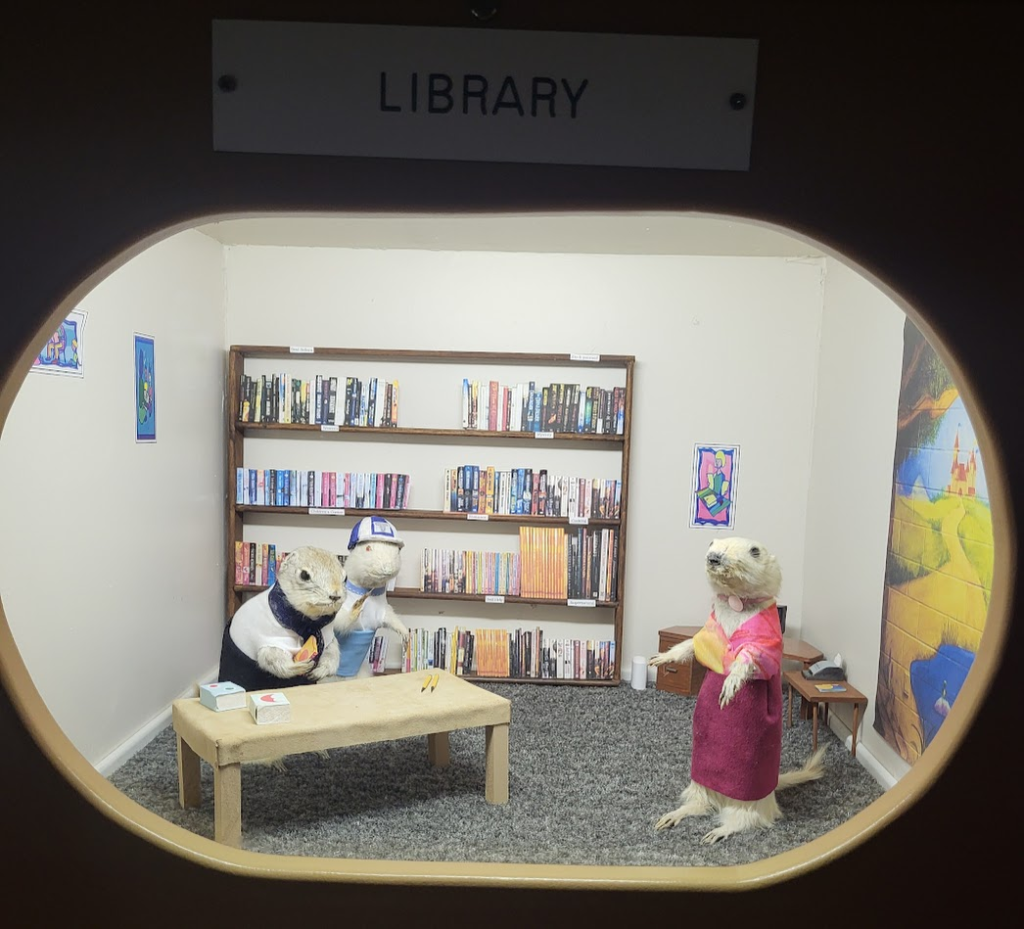
Torrington Public Library.

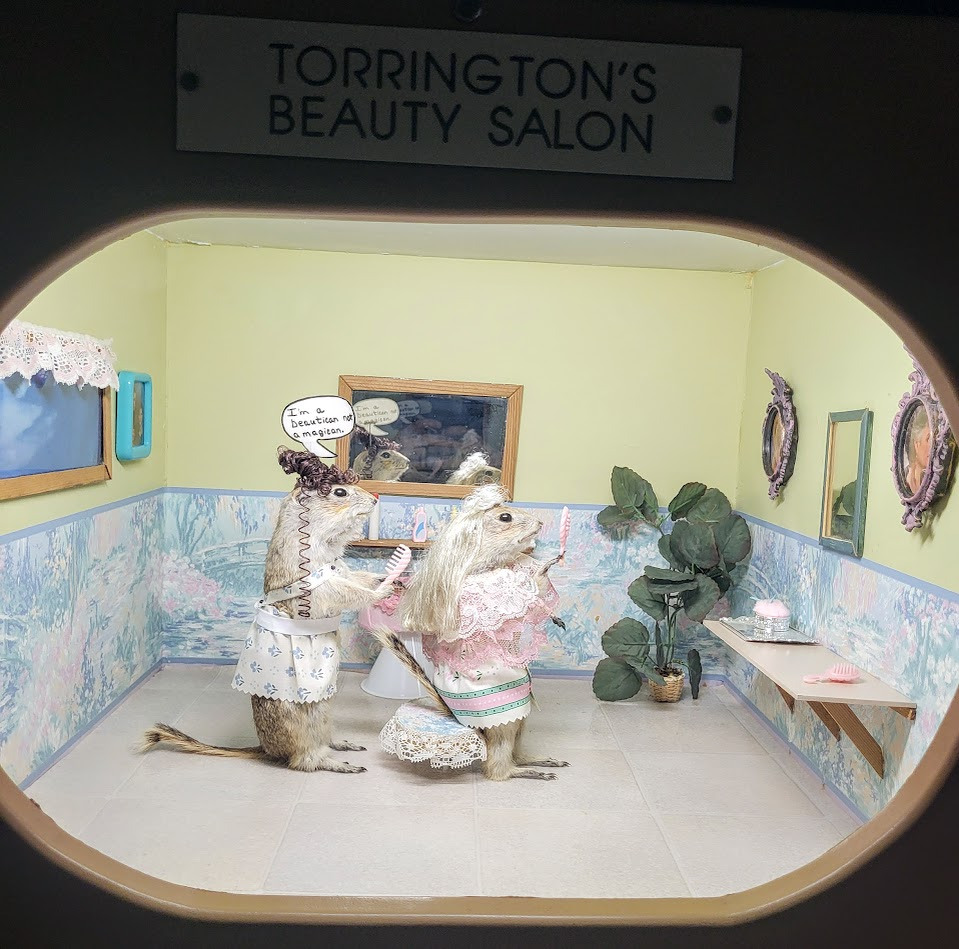
Torrington’s Beauty Salon.

“I’m a beautician, not a magician.”

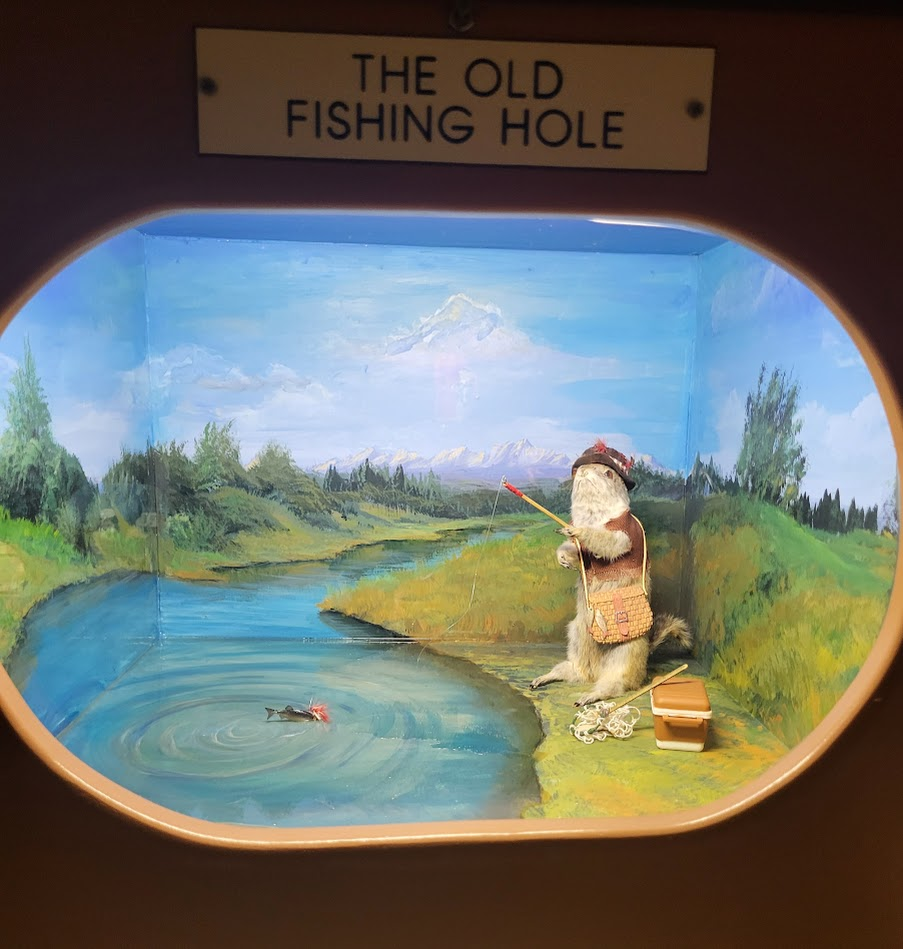
The Old Fishing Hole

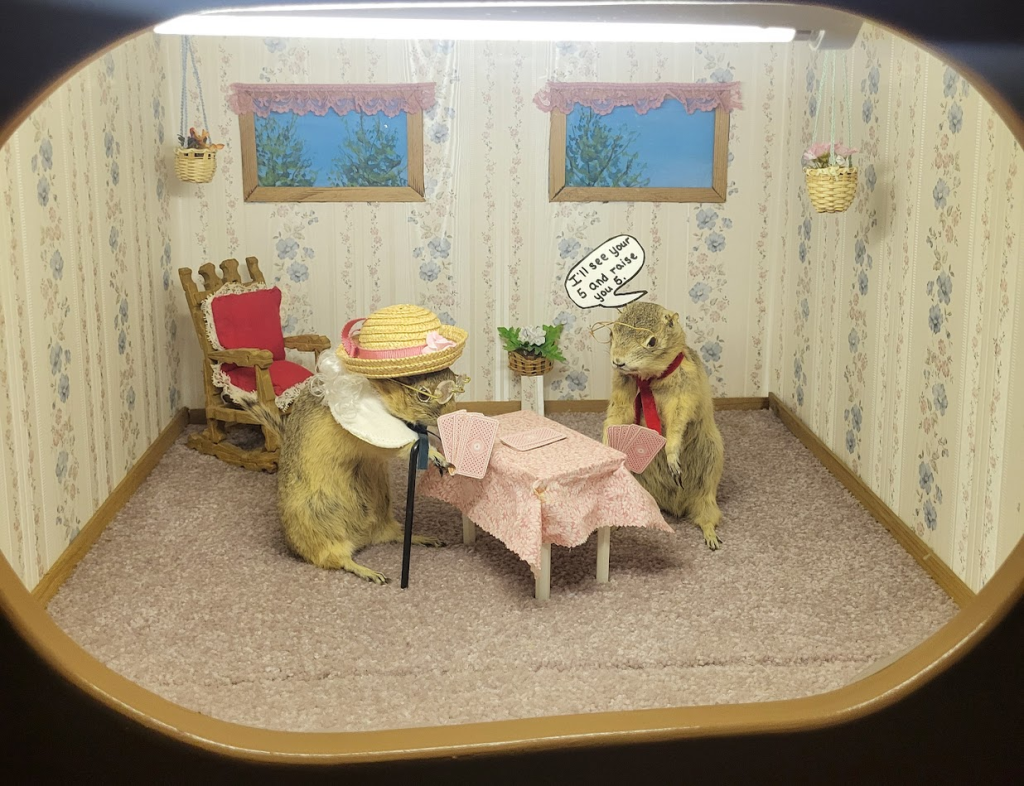
Silver Willow Senior Citizens

“I’ll see your 5 and raise you 5”

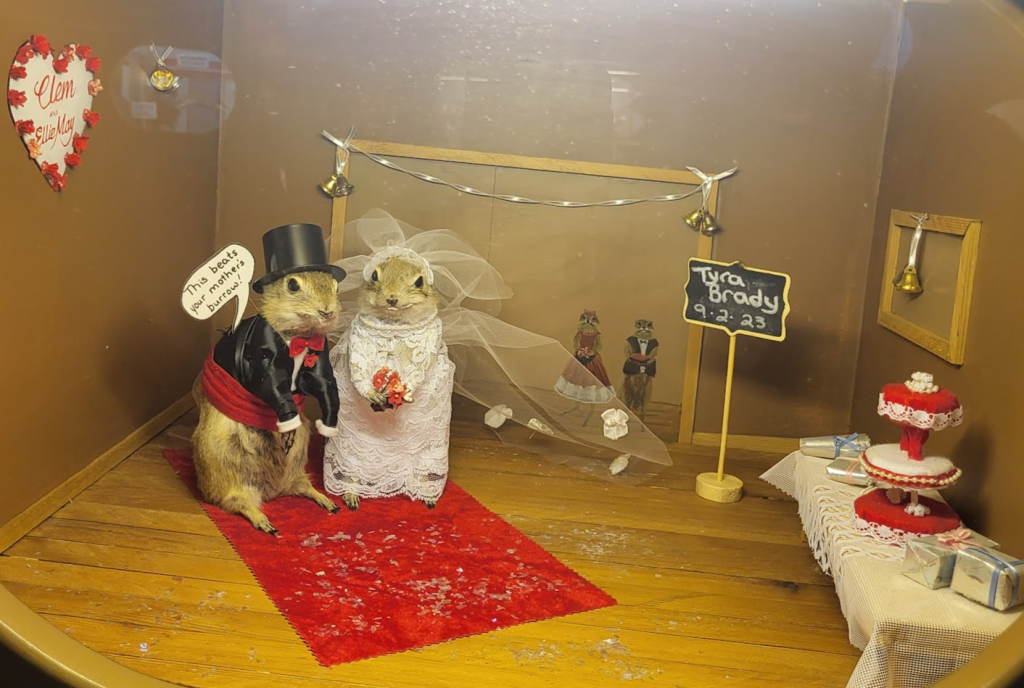
Torrington Community Hall.

“This beats your mother’s burrow”

Parade Day.

I can only guess that they are referring to the Stampede Parade in Calgary since I couldn’t find record of any gopher parades in Torrington.

“Am I in the right town?”

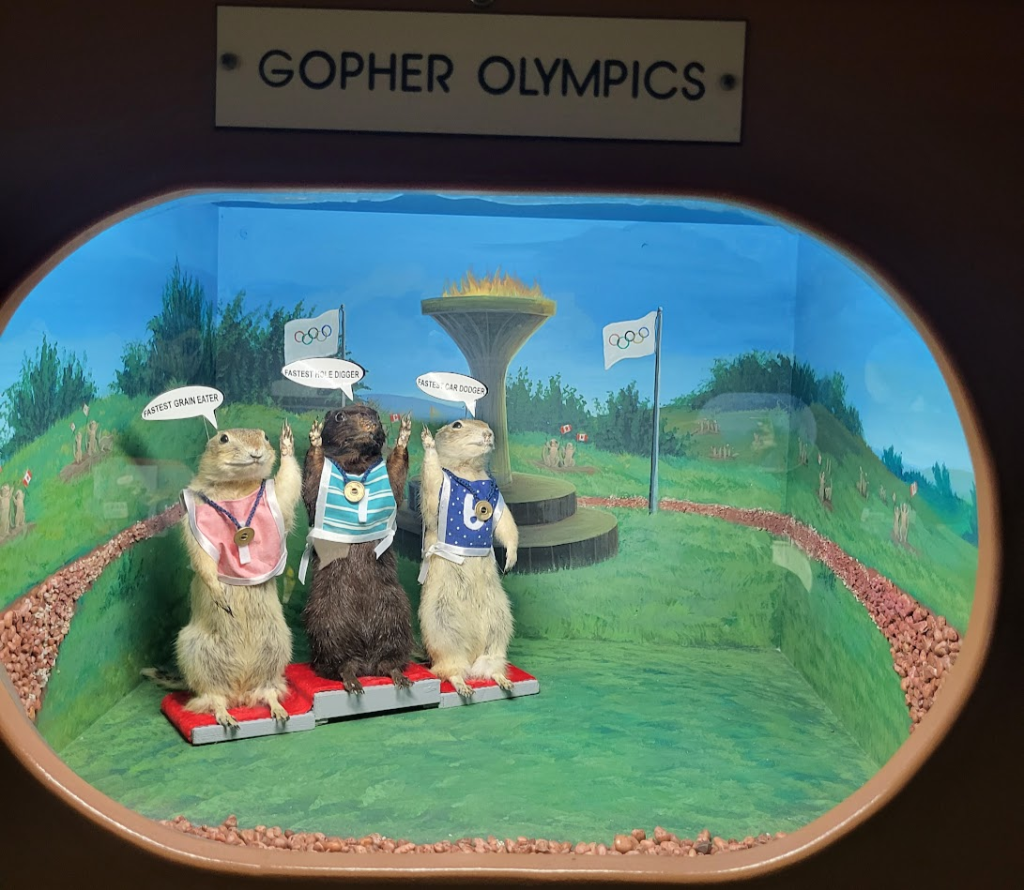
Gopher Olympics

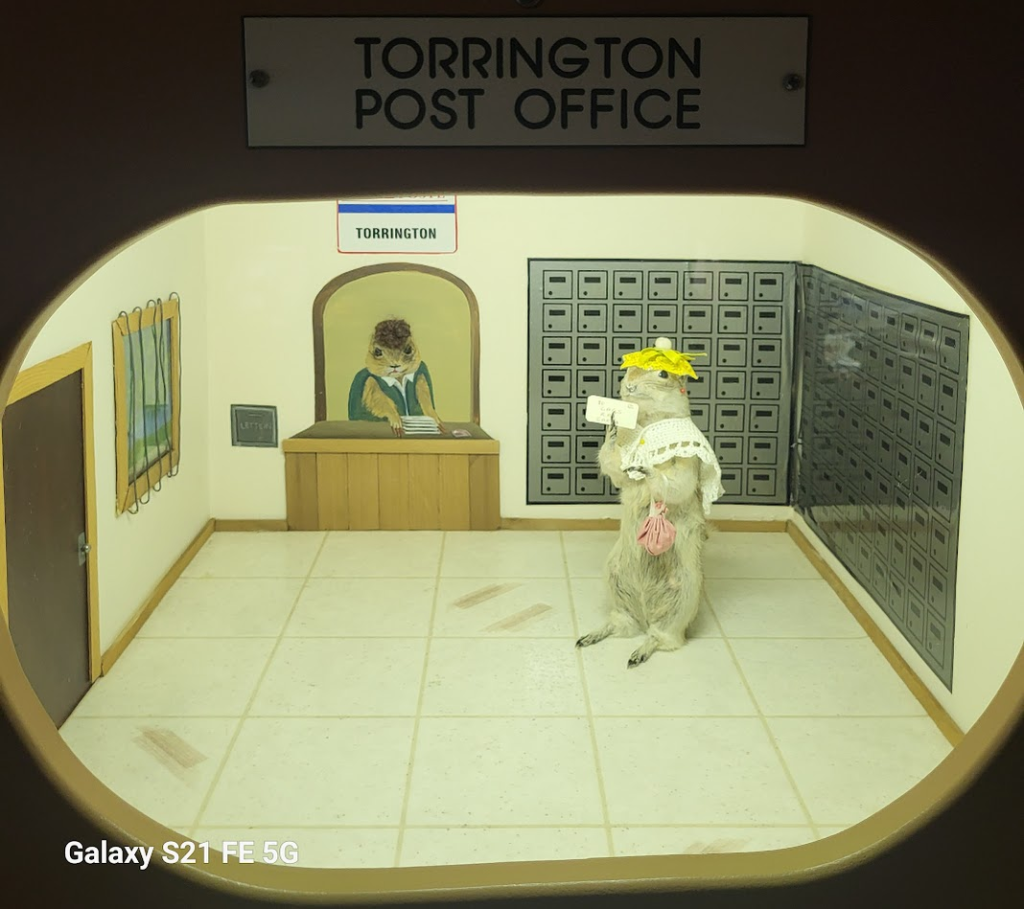
Torrington Post Office

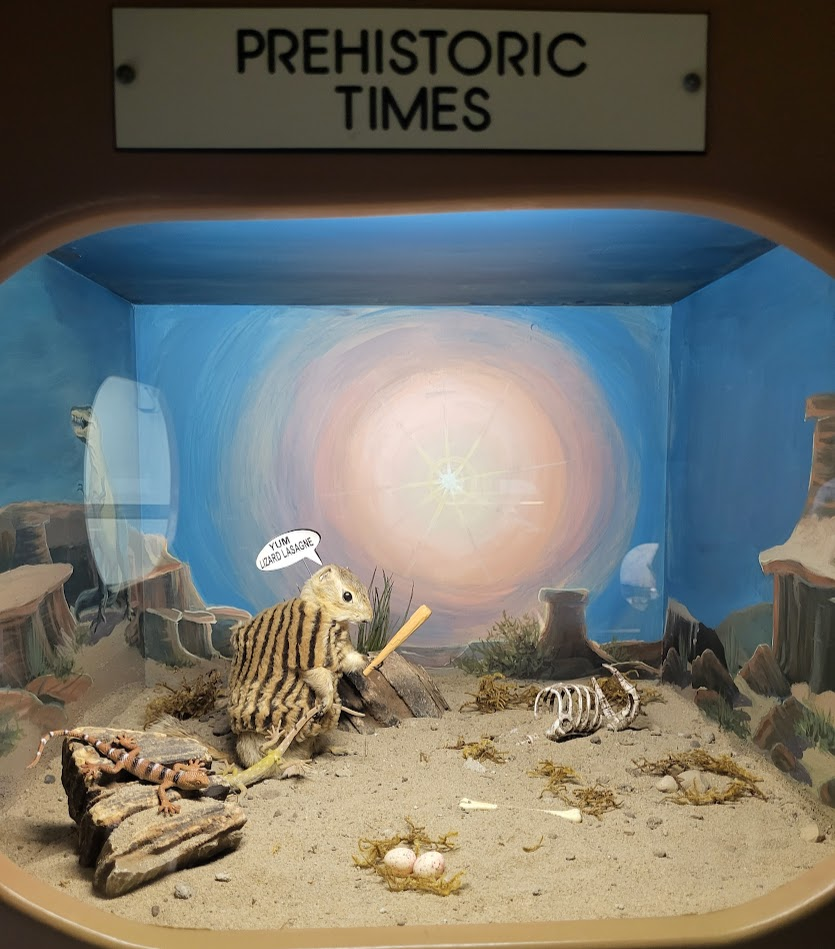
Prehistoric Times

“Yum. Lizard lasagna”

Moonlight Romance.

I guess my only issue with this would be Honda Goldwing.

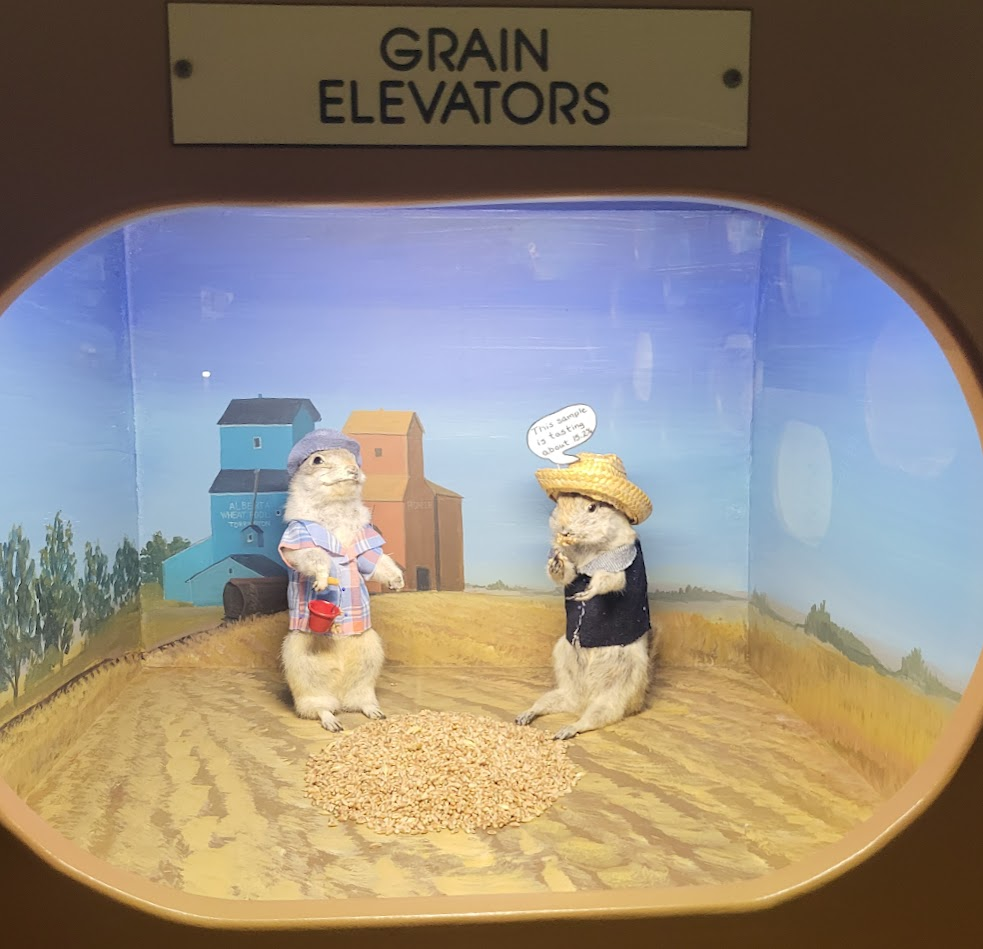
Grain elevators.

“This sample is tasting about 15.2%”

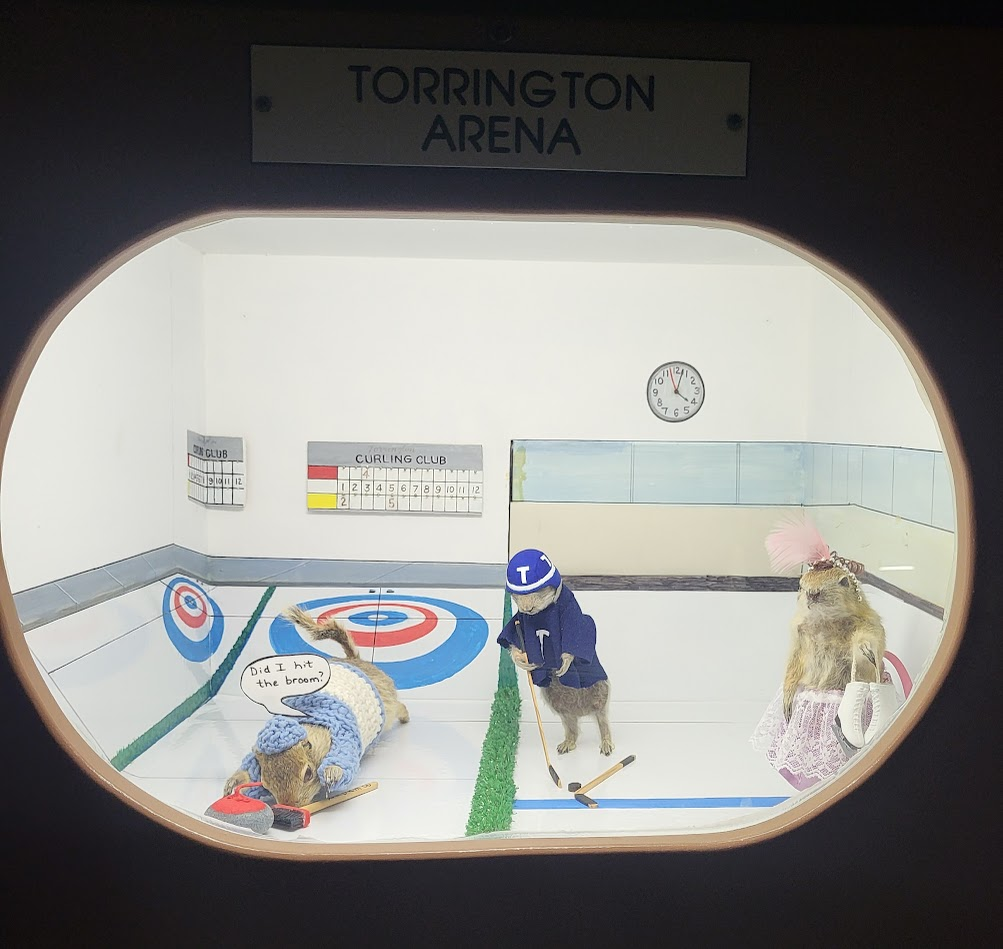
Torrington arena.

“Did I hit the broom?

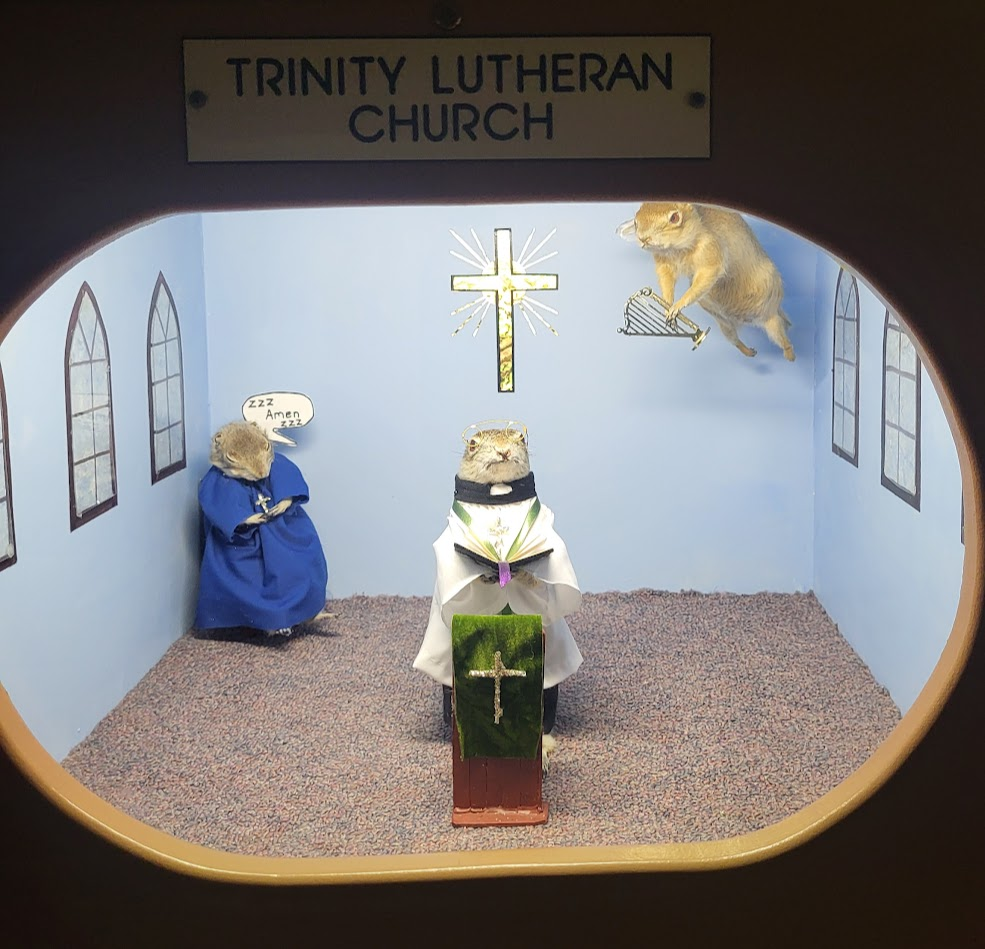
Trinity Lutheran Church.

ZZZZZZZ Amen. ZZZZZZZZ

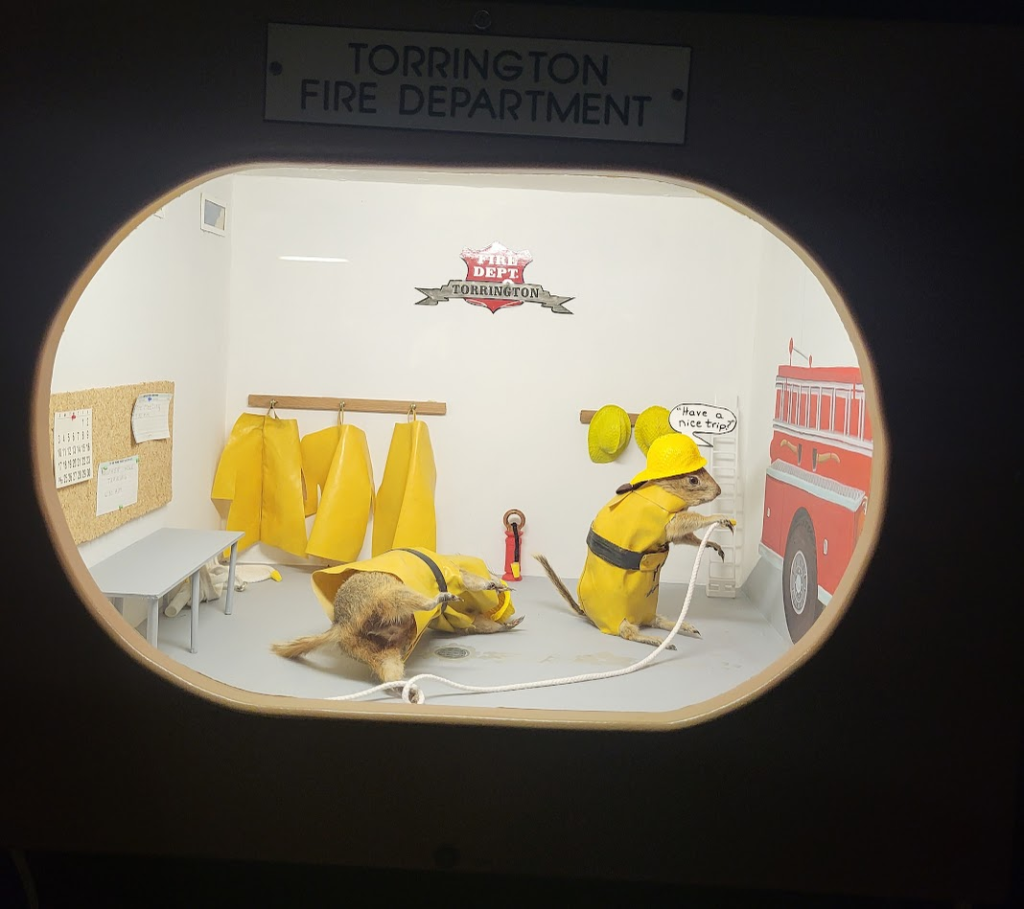
Torrington Fire Department.

“Have a nice trip?”

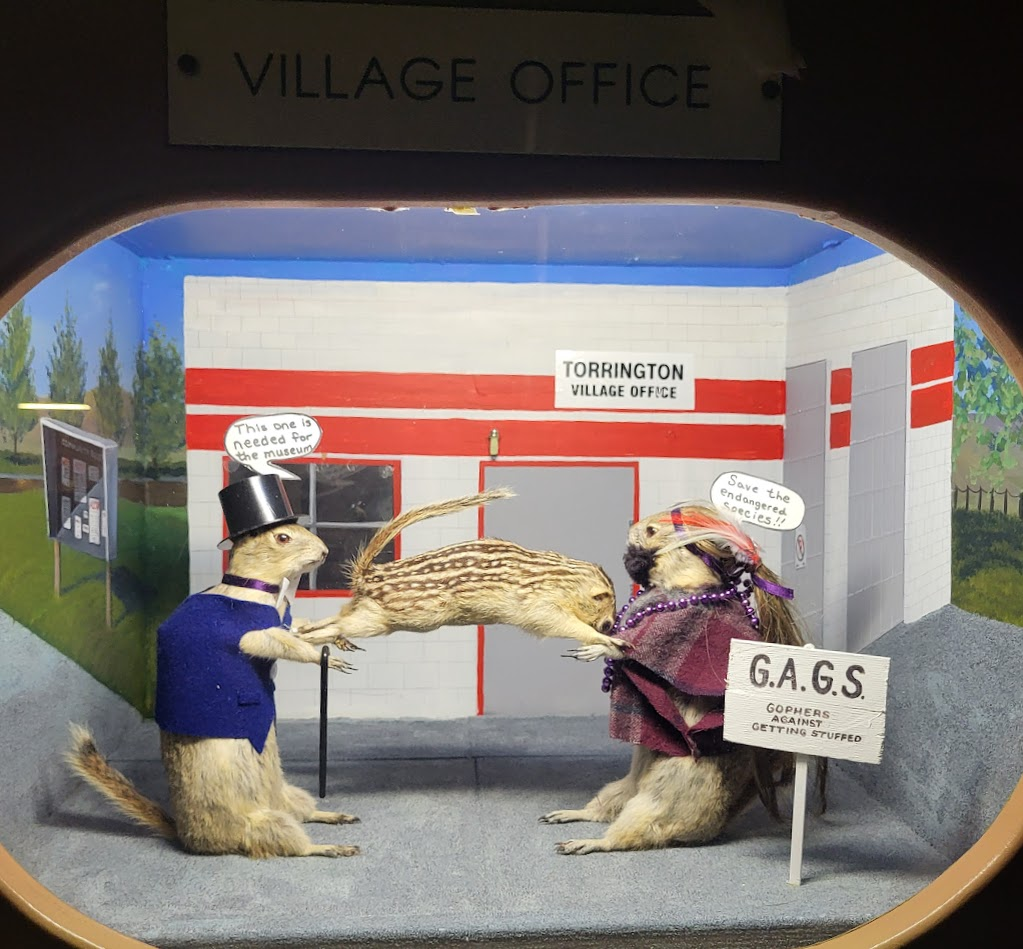
Village office.

Torrington Mobile Home Park.

Pizza ‘N’ More Eh.

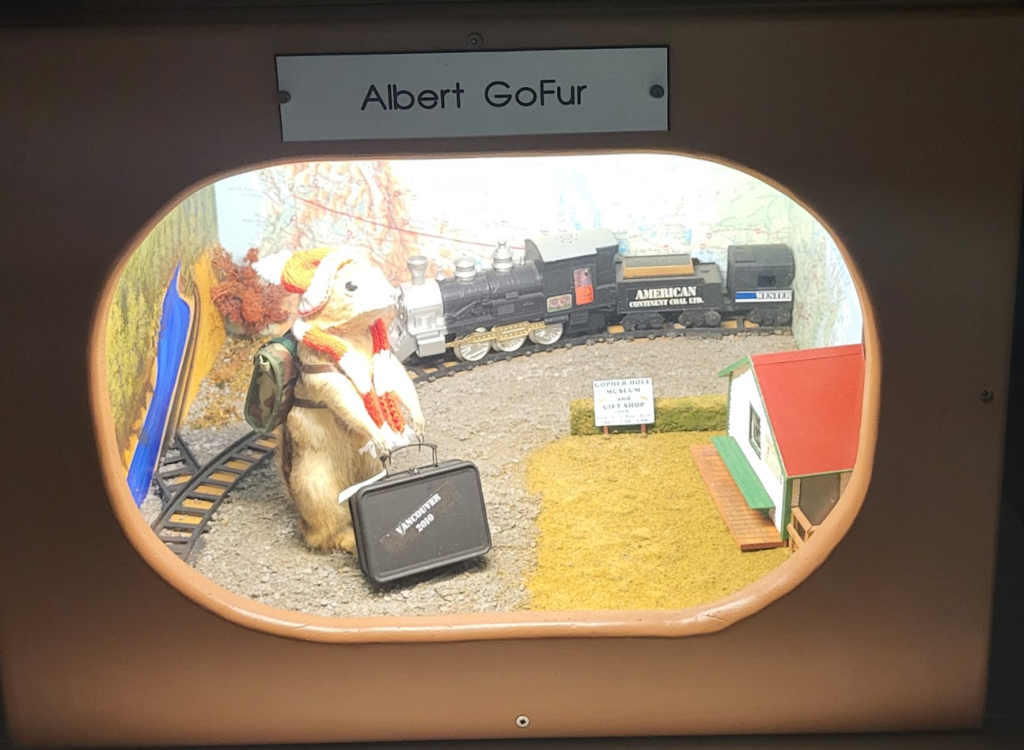
Albert GoFur.

Serenity garden.

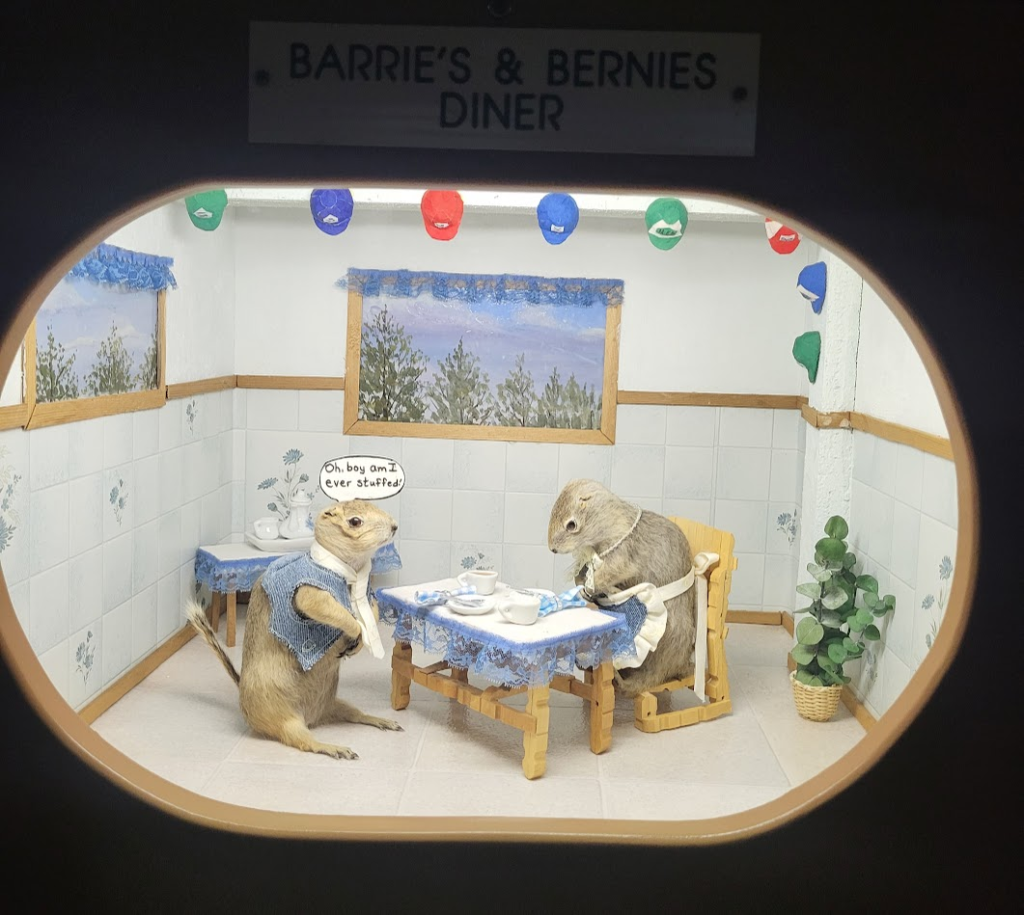
Barrie’s & Bernies Diner.

“Boy am I ever stuffed.”

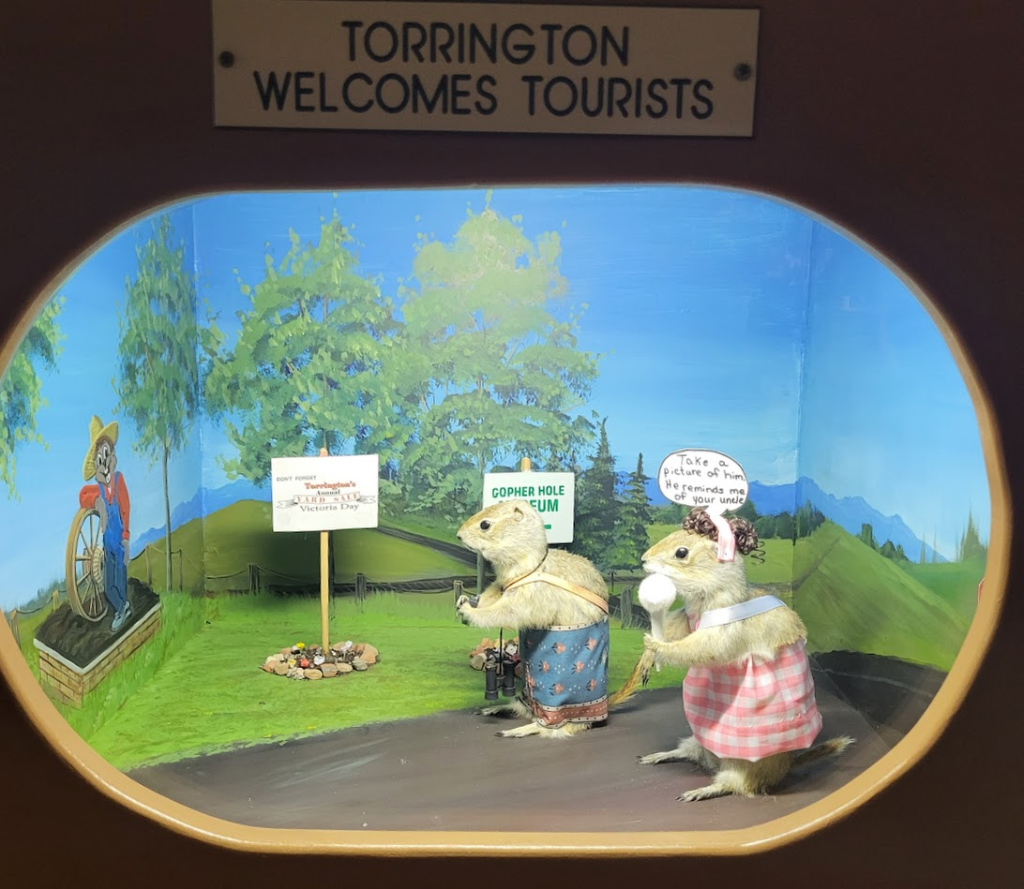
Torrington Welcomes Tourists.

Torrington Fertilizer Plant.

“The real fertilizer is the best.”

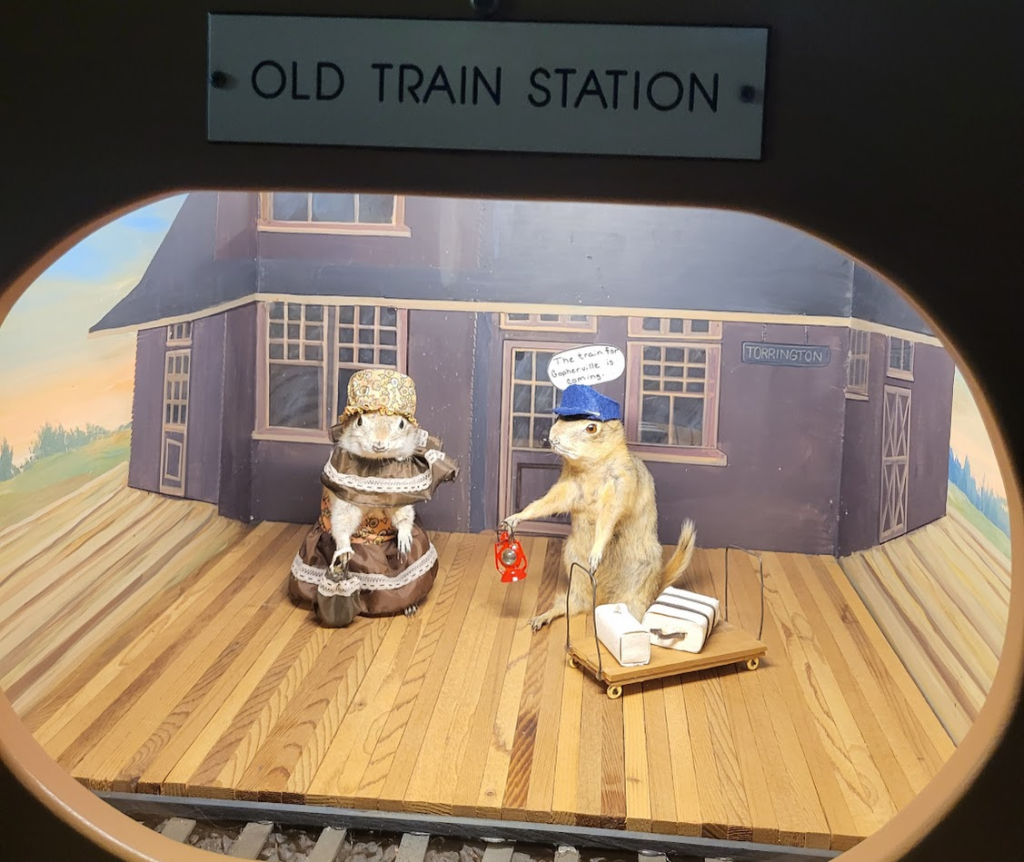
Old Train Station.

Hunting Season.

Old Tyme Music Jamboree.

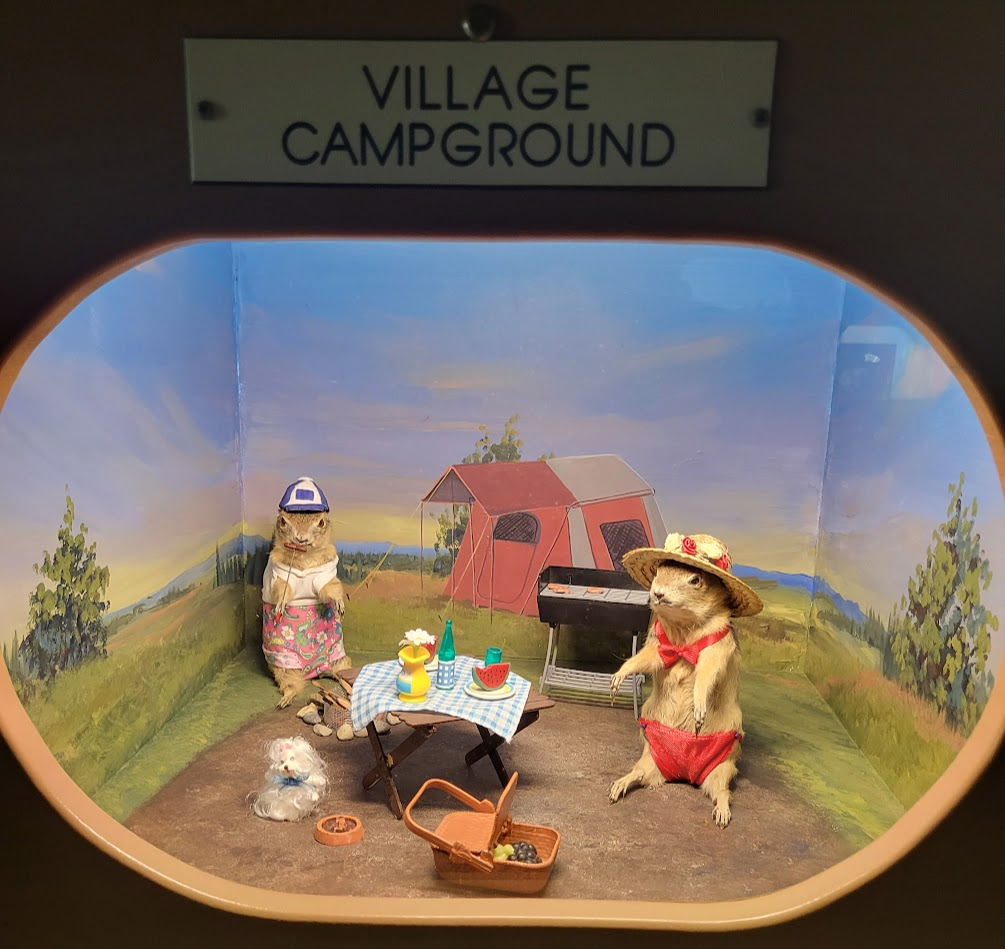
Village Campground.

There’s more to see when you visit Torrington, Alberta’s odd little claim to fame, so if you have any gopher-related vacation plans this summer (like who doesn’t am I right?) or just happen to be in the neighborhood, make sure you drop by.

https://calgary.ctvnews.ca/west-s-weirdest-quirky-alberta-gopher-museum-celebrates-25-years-1.5536631

Express Appreciation For Our Ever Dwindling Population of “Old Guard” Veterans Before It Is Too Late.

How to recognize the campaign stars and medals Canadian troops earned during The Great War, World War 2, and the Korean War.

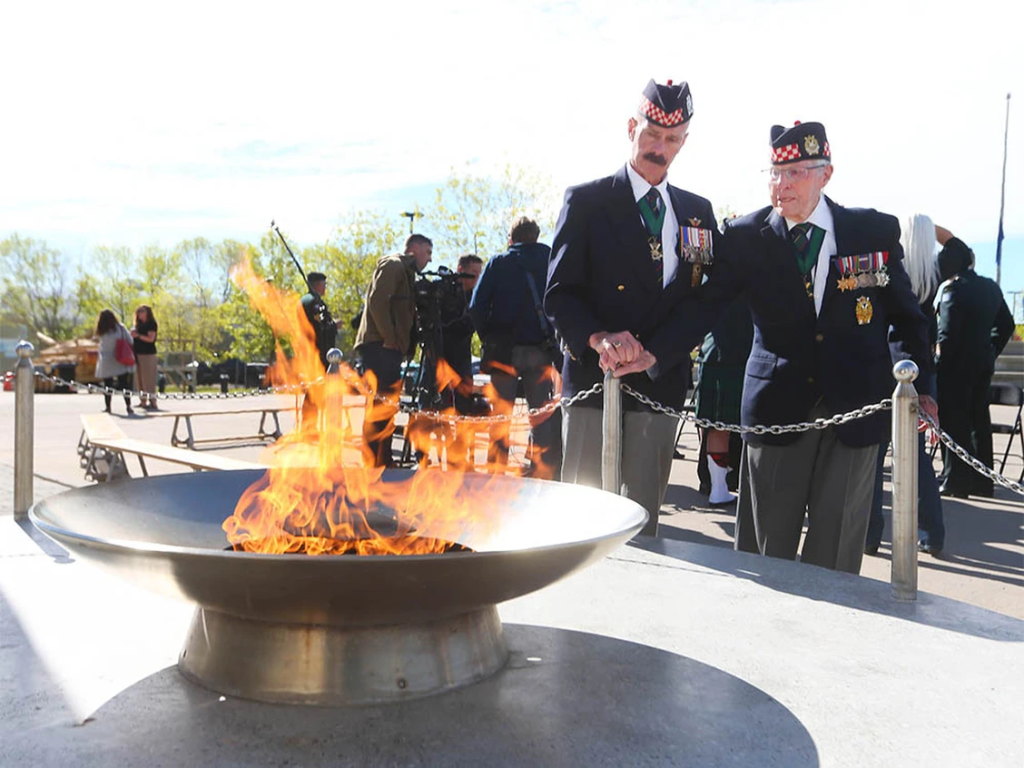
Second World War veteran George Morash is accompanied by Major Kent Griffiths, curator the Calgary Highlanders Museum and Archive, as they pause at the eternal flame following events during D-Day ceremonies at the Military Museums in Calgary on Thursday, June 6, 2024. Jim Wells/Postmedia

https://calgaryherald.com/news/local-news/d-day-80th-anniversary-commemoration-at-the-military-museums

I wasn’t able to attend the D-Day commemoration ceremonies at the Military Museums yesterday morning, however, I was able to stop in at my new home Legion Branch #285 (Calgary Centennial) later on to grab a bite and a beer at around one o’clock. Just as I reached the front door, branch president Kent Griffiths was about to walk out with George Morash, helping the veteran and fellow Calgary Highlander to his car. I held the door open for them, thanking the World War Two veteran for his service as he passed me.

By that time the majority of the senior-most of the “Old Guard” had left the building or were about to depart shortly and I recalled similar occasions from long ago when the oldest of the Old Guard were the veterans of 1914-18. That generation is gone now, and it won’t be long before the WWII generation joins them in the pages of history. It was strange not to see any of the Great War vets and it will seem stranger still to me to no longer see any vets from 1939-1945. Every year they get fewer and fewer, and so do our opportunities to honor and thank them for the sacrifices that they had made in their younger days.

Service Medals and Campaign Stars.

Pretty much universally military medals and decorations fall into one of three categories:

  • Service Medals – Typically these indicate participation in a specific conflict during a specified time and tend to be widely distributed among troops.
  • Campaign Stars – Indicate participation in areas within an active combat area, in the presence of an armed enemy.
  • Awards for bravery or distinguished service – for example the Victoria Cross or DSO.

Only the first two will be covered here.

1914-18 The War to End All Wars.

In February 2010, the last known Canadian World War One Veteran, John Babcock, passed away at his home in Spokane, Washington. Nevermore would these decorations be seen on the chest of a veteran who had earned them.

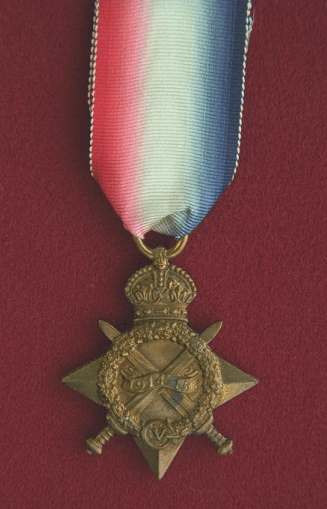
1914-1915 Star

Awarded to all who saw service in any theatre of war against the central powers between 5 August 1914 and 31 December 1915 except those eligible for the 1914 Star. Many Royal Canadian Navy (RCN) small ships were entitled to this star, as Canada considered ‘overseas’ to be service beyond the three mile limit.

British War Medal

The medal was awarded to all ranks of Canadian overseas military forces who came from Canada between 5 August 1914 and 11 November 1918, or who had served in a theatre of war. Those who had enlisted in the Overseas Military Forces of Canada (OMFC) in the United Kingdom and had not served in a theatre of war were not entitled to this medal.
The requirements for Royal Air Force (RAF) personnel were the same as for the Army. Naval personnel were required to have 28 days of mobilized service or to have lost their lives before this period of service was complete. Seamen of the Canadian Merchant Marine who served at sea not less than six months, and crews of Dominion Government Ships and the Canadian Mercantile Marine were also eligible.

Victory Medal (Inter-Allied War Medal)

Awarded to all ranks of the fighting forces, to civilians under contract, and others employed with military hospitals who actually served on the establishment of a unit in a theatre of war between 05 August 1914 and 11 November 1918 (inclusive). It was also awarded to members of the British Naval mission to Russia 1919 – 1920 and for mine clearance in the North Sea between 11 November 1918 and 30 November 1919. This medal was always issued with the British War Medal.

World War 2 – The Greatest Generation.

There were 13 service medals and campaign stars available to be awarded to Canadian soldiers, sailors, and airmen during WW2 in numerous colours and patterns. These troops were not limited to being awarded only these decorations however, as several were often decorated with honours from other countries such as the French Legion of Honor, so if you happen to see a medal being worn by someone that isn’t listed here, that is the reason why that is.

My maternal grandmother had five brothers who fought in Europe, all came home physically intact. Uncle Johnny, Uncle Tommy, Uncle Alfred, Uncle Bill, and Uncle Donald all volunteered although I can only ever remember seeing Uncle Bill and Uncle Donald wearing their medals on their respective blazers. They told some stories about the war, but by and large, it was something they didn’t really talk about much.

1939-1945 Star

The 1939-1945 Star is a Second World War medal that was issued between 02 September 1939 and 08 May 1945 (Europe) or 02 September 1945 (Pacific). The medal was awarded for six months service on active operations for Army and Navy, and two months for active air-crew.

Atlantic Star


Issued between 03 September 1939 and 08 May 1945 (Europe) or 02 September 1945 (Pacific). The Atlantic Star was awarded for six months of service afloat or two months for air-crew service and was not awarded unless the recipient was qualified for the 1939-1945 Star by six months of operational service afloat or by two months of airborne service. Therefore, the total requirement was twelve months of service afloat or four months of airborne service.

Air Crew Europe Star

Issued between 03 September 1939 and 05 June 1944. It was not awarded after D-Day. The Air Crew Europe Star may not be awarded until the 1939-1945 Star has been qualified for by 2 months service in an air operational unit. The total requirement to earn both stars is four months.

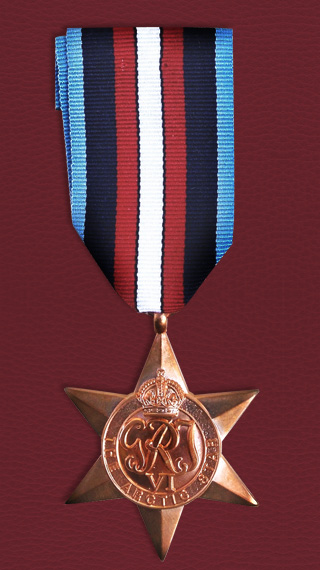
Arctic Star

Granted for operational service of any length, from September, 3, 1939, to May 8, 1945 inclusive, north of the Arctic Circle (66 degrees, 32’N) on the Greenland Sea, Norwegian Sea and Barents Sea.
Eligibility is defined as follows:
Navy and Merchant Navy – Eligibility for Naval and Merchant Navy service anywhere at sea north of the Arctic Circle is to include, but is not limited exclusively to, those ships participating in, and in support of, convoys to North Russia.
Air Force – Aircrew of the Royal Canadian Air Force will be eligible if they landed north of the Arctic Circle or served in the air over this area. Non-aircrew on operational service in the area are also eligible.
Army – Army personnel serving in His Majesty’s Canadian ships or in defensively equipped Merchant ships qualify under the rules applying to the Navy or Merchant Navy. In addition, personnel taking part in land operations north of the Arctic Circle will also be eligible.
General – Service on the Greenland Sea outside of the coastal limit, Norwegian Sea and Barents Sea within the Arctic Circle are areas of service for eligibility to this star.
General – Eligibility to the Arctic Star has no effect upon eligibility for Second World War recognition previously awarded and does not suggest automatic eligibility for any further awards.

Africa Star

The star was awarded for a minimum one day service in an operational area of North Africa between 10 June 1940 and 12 May 1943. Bars First Army: Awarded for service with that army between 08 November 1942 and 12 May 1943. A ‘1’ is worn on the ribbon in undress to denote this bar.
Eighth Army: Awarded for service with that army between 23 October 1942 and 12 May 1943. An ‘8’ is worn on the ribbon in undress to denote this bar.
North Africa 1942-1943: Awarded for service with the Navy, Merchant Navy, Air Force or headquarters of the 18th Army Group between 23 October 1942 and 12 May 1943. In undress, a rosette on the ribbon denotes this bar.
Only one bar is worn and when the ribbon is worn alone a ribbon emblem, ‘8’, ‘1’ or silver rosette as appropriate is worn to denote the award of a bar.

Pacific Star

The star was awarded for one day or more of operational service in the Pacific between 08 December 1941 and 02 September 1945.
Navy and Merchant Navy personnel are eligible if the 1939-45 Star is earned by six months service or if they entered the Pacific Theatre between 2 March 1945 and 2 September 1945.

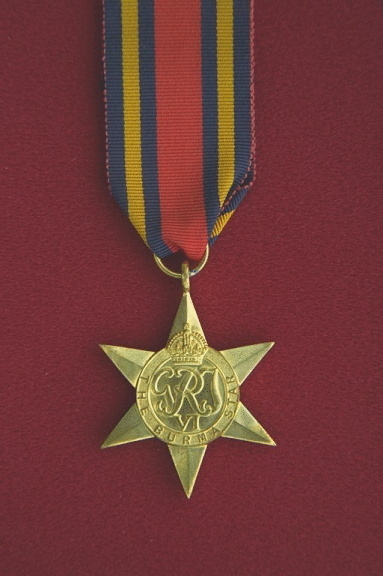
Burma Star

The Burma Star was issued between 11 December 1941 and 02 September 1945. In addition for:
Navy – six months qualifying service for 1939-1945 Star first, then operational service in the Bay of Bengal and in the Malacca Strait;
Army – service on land in Bengal and Assam from 1 May 1942 to 31 December 1943, areas of Bengal and Assam east of the Brahmaputra from 1 January 1944 to 2 September 1945 and operational service in China and Malaya from 16 February 1942 to 2 September 1945; and
Air Force – one operational sortie for aircrew and qualifying service as for Army for other Air Force personnel.

France and Germany Star

The star was awarded for one day or more of service in France, Belgium, Holland or Germany between 06 June 1944 (D-Day) and 08 May 1945.

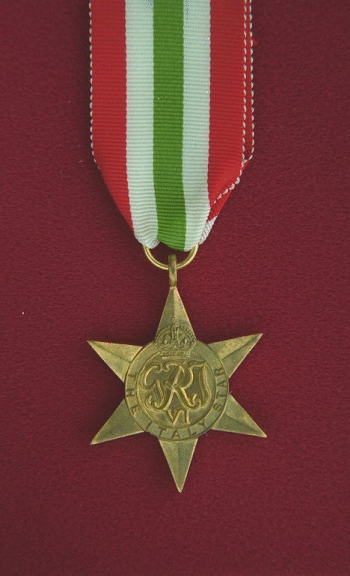
Italy Star

Awarded for one day operational service in Sicily or Italy between 11 June 1943 and 08 May 1945.

Defence Medal

Although the medal was usually awarded to Canadians for six months service in Britain between 03 September 1939 and 08 May 1945, the exact terms were: Service in the forces in non-operational areas subjected to air attack or closely threatened, providing such service lasted for three or more years. Service overseas or outside the country of residence, providing that such service lasted for one year, except in territories threatened by the enemy or subject to bomb attacks, in which case it was six months prior to 02 September 1945.
Under the terms of this last condition, Canadians serving for one year in Newfoundland were eligible and persons serving for six months in Hong Kong were also eligible. The qualifying period in mine and bomb disposal was three months. Canadians serving in West Africa, Palestine and India, other than operational air crew, qualified for this medal. Those awarded the George Cross (GC) or George Medal (GM) for civil defence received this medal. Home Guard and others in Britain qualified for this medal.

Canadian Volunteer Service Medal

The CVSM is granted to persons of any rank in the Naval, Military or Air Forces of Canada who voluntarily served on Active Service and honourably completed eighteen months total voluntary service from 3 September 1939 to 1 March 1947.

Newfoundland Volunteer Service Medal

The government of Newfoundland and Labrador shall award a medal to every person:
who volunteered and served in units or organizations raised or maintained as the contribution of the Dominion of Newfoundland to the allied war effort, namely, the British Imperial Forces, the Newfoundland Overseas Forestry Unit, the Merchant Navy and the Newfoundland Regiment, or, a unit or organization prescribed by the Lieutenant Governor in Council; and
who is ineligible for or has not received a volunteer war service medal from another country.

War Medal 1939-1945

Awarded to all full-time personnel of the Armed Forces and Merchant Marines for serving for 28 days between 03 September 1939 and 02 September 1945. In the Merchant Navy, the 28 days must have been served at sea.

Bars

Hong Kong Bar

The Hong Kong Bar is awarded to those involved in the Battle of Hong Kong during the period December 8 – 25, 1941. The said bar is worn on the Canadian Volunteer Service Medal ribbon.

Bomber Command Bar

The Bomber Command Bar is awarded to Canadian Veterans who, regardless of rank or role, served a minimum of one day with Bomber Command between September 3, 1939, and May 8, 1945 (Victory in Europe Day).
Recognizing that the successes of Bomber Command started on the ground and finished in the air over Fortress Europe, all Canadian Bomber Command Veterans who earned the Canadian Volunteer Service Medal (CVSM), regardless of rank or role, are eligible for the honour.

Dieppe Bar

The Dieppe Bar is awarded to those who participated in the Dieppe Raid on August 19, 1942, and is worn on the Canadian Volunteer Service Medal ribbon.
A silver bar, to be attached to the ribbon of the Canadian Volunteer Service Medal (CVSM), has been designed featuring the word DIEPPE in raised letters on a pebbled background. Above this, the bar bears an anchor surmounted by an eagle and a Thompson sub-machine gun. The design was created in consultation with the Dieppe Veterans and Prisoners of War Association.

The Korean War.

Sitting at an empty table, I ordered a bottle of Pilsener beer and a plate of grilled perogies with sour cream, onions, and bacon bits for lunch. A couple of tables away sat a Korean War veteran, enjoying a cold beer with his son. I would come to find out that his name was Sam and before I left I wanted to pay him a visit. I told him that I had an uncle who had fought in Korea and he told me that he served in the Navy during the war. I thanked him for his service, and he said he didn’t think many people would even recognize his medals, but I did. He gave me a firm handshake, and I told him I wanted to buy him that beer he was drinking. His son had just paid the bill, but I left him some money to cover his next one and told Sam that he had already paid for that beer a long time ago.

Korea – First Conflict of The Cold War and to see UN Participation.

It was in the Korean War that troops from the United Nations would make their premiere appearance, and they would do things slightly different than before. Whenever they were deployed, UN troops were seen to be on a “mission” as opposed to being on “campaign”, thusly there were no United Nations “Campaign Stars” awarded despite troops potentially being engaged in a hot-shooting war scenario. Instead they were considered “service medals”.

Canadian Korea Medal

 Awarded to Canadian military personnel for one day on the strength of an army unit in Korea; or 28 days afloat; or one sortie over Korea by a member of the RCAF, 02 July 1950 – 27 July 1953.

Canadian Volunteer Service Medal for Korea

Established in 1991 for service between 27 June 1950 and 27 July 1954. A former member of the Royal Canadian Navy, the Canadian Army or the Royal Canadian Air Force is eligible to be awarded the medal where the member:
was in the Canadian armed forces during all or part of the period from 27 June 1950 to 27 July 1954:
was in the qualifying area (defined as Korea and the adjacent areas, including Japan, Okinawa and Korean waters); and
during the period referred to in (a),was on the strength of an army unit or formation in Korea for at least one day;
was on active service for at least 28 days on a ship or craft engaged in operations in the qualifying area;
flew one sortie over Korea or over Korean waters in the Yellow Sea or East Sea (Sea of Japan), or:
accumulated at least 28 days service in the qualifying area.

United Nations Service Medal (Korea)


The United Nations Service Medal was instituted 12 December 1950 for service from 27 June 1950 to 27 July 1954 and was earned for serving one day under United Nations’ command in Korea or adjacent areas, including Japan and Okinawa. The medal could also be awarded for an aggregate of thirty days, which need not have been consecutive, spent on official visits of inspection to the qualifying area. The qualifying period was 27 June 1950 to 27 July 1954 (One year longer then in the case for the Canadian Medal for Korea).

Visit the VAC website for more information.

Photos and information used herein were provided by Veteran’s Affairs Canada. Visit the webpage linked below to find information about Canadian Honours and Decorations from Confederation to the present day.

https://www.veterans.gc.ca/en/remembrance/medals-decorations

Seven Days in Ottawa – Day 1

For Wolf.

Lt. Wolf Wm Solkin was a Canadian hero and a personal one to myself and many others. As a young man, he volunteered to fight tyranny in Europe, and when he came home he would continue fighting. He would battle against all levels of government until he died, tenaciously fighting for and on behalf of veterans. I saw him as the Dean of Canadian Veteran’s Advocacy and, after he left us shortly before his 98th birthday three years ago, even though he wasn’t a Catholic, I would think of him as its Patron Saint.

We miss you, Wolf.

This is for you.

Saturday, 12 February.

Off to Ottawa.

Weather observations – Calgary 12 February 2022

It was a mild 1 degree Celsius (32 degrees Fahrenheit) at 7AM when I arrived at the airport, and a Chinook arch was visible as the sun rose and I waited in the lounge to board the 9AM flight to Ottawa. Usually, I like to be among the first in line, but I wasn’t looking forward to being on this plane for any longer than was absolutely necessary. Although restrictions were starting to be lifted in Alberta, wearing a mask was still mandatory aboard all aircraft and I was about to be on one for roughly five and a half hours.

My vaccine status and position on the issues.

Vaccine status.

Obviously, since I was able to board an aircraft at that time, I had to have at the very least received the first two COVID-19 inoculations to get my “vaccine passport” which would allow me to do so. It was only after a great deal of consideration that I decided to get those injections, and I would be making as informed a choice as one could hope to expect at the time. I was well aware of the potential risks that would or possibly could come with this vaccine, but then, I also knew that I was facing a certain degree of risk every time I was prescribed a drug that was new to me.

I know that there are people out there who would call me a sheep for having decided to get the vaccine. To them, I would say that it is because of that kind of rigid black-and-white thinking that we now find ourselves in the predicament we currently find ourselves in, not just as a country but across the globe.

Believe me when I say that I had spent a considerable amount of time learning just exactly how little one can place one’s trust in either government or the pharmaceutical industrial complex. I’m not given to swallow everything that I am fed, particularly when it comes to those two entities. Having weighed the pros and cons, I decided that I would get the first two shots should I ever need to do some business travelling. Turns out that I was right on that point.

Pandemic response and aftermath.

I could write another series about my thoughts on the response to the pandemic and its subsequent aftermath, but, for the sake of brevity, I will attempt to summarize my position as succinctly as possible while not appearing to be glib about it.

https://nationalpost.com/news/students-around-the-world-suffered-huge-learning-setbacks-during-the-pandemic-study-finds

Time has gone on to prove that, in Canada and the United States at least, the socio-economic fallout will be felt for years to come as a result of how this was (mis)handled by our elected officials. While it didn’t turn out to be the catalyst for governments to start locking people up in camps as some had feared, it was the cause of deep divisions in a society that was already rife with division. We were weakened even further, much to the delight of our enemies, among them the People’s Republic of China, Russia, North Korea, and Iran, not to mention non-state actors like religious fundamentalist groups and other terrorist organizations (Hamas, Hezbollah, etc,).

English historian Dr. David Starkey provides an interesting take on inflation, comparing what happened in the post-war era economies following the two World Wars to what occurred in the wake of what he calls the “Covid phoney war”.

The Freedom Convoy.

Leadership/organization.

There seemed to be several people whose names were being mentioned in the media as being associated with the Freedom Convoy in some capacity, typically as an “organizer”. Of these, however, three would stand out more than the others.

Tamara Lich & Chris Barber.

Convoy protest organizers Tamara Lich (left) and Chris Barber stand co-accused of mischief, obstructing police, counselling others to commit mischief and intimidation for their roles in the 2022 convoy protest. PHOTO BY TONY CALDWELL/POSTMEDIA, JUSTIN TANG/THE CANADIAN PRESS

At the time I wasn’t familiar with either Tamara Lich or Chris Barber, so I had no basis on which to form an opinion of them other than that they were both passionate about how they felt and were willing to act on their principles. As for the GoFundMe effort, I didn’t contribute to it because it wasn’t clear who would be administering it, how the funds were to be spent, etc.. It wasn’t so much a matter of thinking the funds would be stolen as it was a seeming lack of organization on their part. Saying this, trying to organize something like this would be a monumental task taking at the very least several weeks of planning by numerous people, all of whom are singing off the same sheet as it were.

My only real concern was that it might not get much support east of Manitoba given Lich’s separatist affiliations, although she did resign from her position in the Maverick party in early February of 2022 to dedicate all of her attention to the protest.

Tamara Lich and Chris Barber both face four charges, with Lich spending 48 days in custody before being granted bail, while Barber was released the day after his arrest.

Pat King.

Courtesy: Facebook

Pat King however was a name that I was familiar with, as I knew of him through various Facebook pages and groups that I belonged to. After seeing some of his posts and talking with several people, I concluded that he was an opportunist who had previously misrepresented himself to the veteran community. I’ve heard from more than a few veterans who referred to him as a grifter. Quite frankly I would trust the man about as far as I could throw him, and I felt that his presence could only prove detrimental to the cause.

He is facing 16 charges and spent 150 days in custody before being granted bail.

The capriciousness of Canadian criminal justice.

Despite how I may feel about Kimg personally I do not think that he deserved to spend five months in jail before being granted bail, and in both his and Tamara Lich’s case, the amount of time spent in custody seems disproportionate to the crimes being charged, especially when because people charged with far more serious crimes have seen much less time behind bars awaiting trial.

As of the time of this writing, Lich and Barber’s trial remains adjourned, while King’s trial is slated to begin in May of this year.

Western Separation.

At one time I was among those in Alberta who believed that the West would be better off breaking away from Confederation and doing our own thing, it was a belief that I had held onto from the time I was old enough to vote. After all, I grew up during the reign of the first Trudeau and the economic ruin he inflicted on my home province with the National Energy Program, so I was all about breaking away from Ottawa and committing to the fight.

Things started to change for me about five years ago, however. For one thing, when I decided to become an advocate for veterans, it was to be for all veterans no matter where they lived or were from, east or west. I had also grown tired of the Western Separatist movement being nothing but talk, all sizzle and no steak. No charismatic leader has yet emerged with a comprehensive plan that will detail how they would address every aspect of separation that would need to be addressed, and I would expect such a plan to be at least several hundred pages long, not laid out in bullet form on two or three. Until such time comes, I find that it would be just a waste of time for me to even think about it, I have better things to be doing.

Wheels down.

Weather observations – Ottawa 12 February 2022

The mask was gone the moment I was off the aircraft and on the jetway, making a beeline for the main entrance so that I could have a cigarette and catch up with events online. As soon as I stepped outside I was hit with an arctic blast, as temperatures in Ottawa began to plummet and the wind started to gust steadily while I was en route. I knew that this bitter cold would greet me on my arrival, but it didn’t prepare me for the frigid shock. I lit a cigarette and discovered that while I was in the air the fence that had been put up around the National War Memorial had been taken down by a group of veterans, in a move decried by the evidently clueless Minister of Veteran’s Affairs, Larry MacAulay.

Somehow MacAulay failed to understand was, to veterans, that damn fence was just as much a desecration of the memorial as the acts committed by the ignorant protester. To suggest that veterans would intentionally disrespect the War Memorial was completely asinine and foolish on his part. In fact, after removing the barricade, there was an almost constant presence of veterans standing watch at the monument to ensure that no further acts of desecration would be committed by anyone. They wouldn’t abide the behaviour of knucklehead fools, no matter who they were, protestor or otherwise. I would spend several hours there myself that week, at times going in the middle of the night when things were quiet to keep vigil over the unknown soldier entombed there. I resolved that if and when the situation escalated, it would be where I made my last stand.

I finished smoking that cigarette in a hurry, eager to return to the terminal’s warmth and headed to wait for my baggage to land on the carousel. A short time later I was in a cab headed downtown, listening to the local news as it played on the car’s radio.

Forward Operating Base (FOB) Ottawa.

Also known as the Holiday Inn Express & Suites Downtown on King Edward Avenue and conveniently located 2 kilometres, about a ten-minute walk, from the National War Memorial, it would be my base of operations for the week. As the cab pulled into the carport, I could see a group of people with Canadian flags going into the hotel and was happy to see that there would be other people of like mind staying in the hotel. I checked in and went to wait for an elevator to take me upstairs, and was joined by an attractive young woman who had also just checked in. As we got on the lift she asked if I was in town with the convoy, and I told her that I wasn’t “with” them but that was why I was there. I told her that I was a writer and freelance investigative journalist and had just flown in from Calgary. I in turn found out that she had just arrived from Vancouver and was a lawyer considering a run in local politics. As I was about to exit onto my floor she gave me her business card and I immediately recognized her last name as being Ethiopian. I thanked her and said that I would likely be seeing her around.

Dinner out – Chez Lucien.

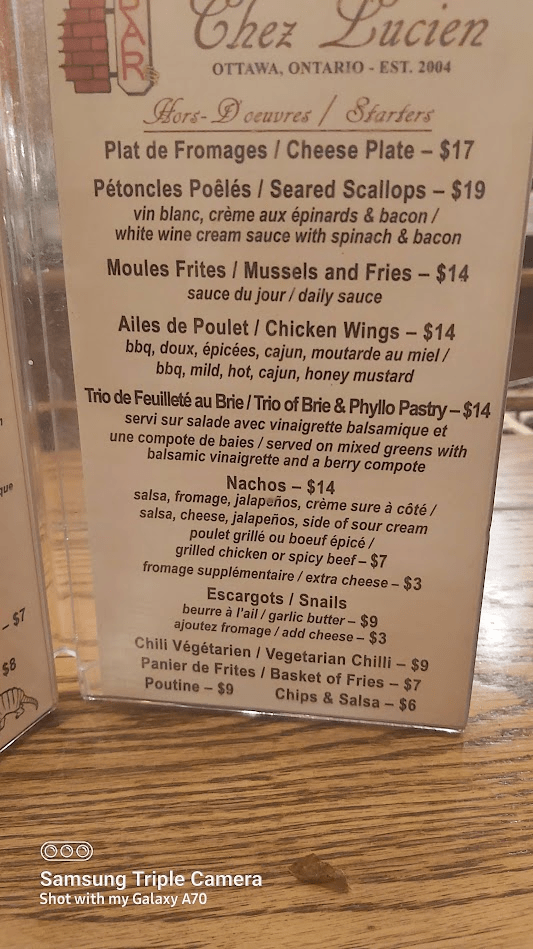
After getting settled in at the hotel I wanted to get something to eat, and I wasn’t about to have fast food on my first night in Ottawa, so I searched online for a place within a few blocks since I really didn’t feel like walking a long way in the frigid weather. Chez Lucien was only a couple of blocks to the west and looked like a good place to relax and have a couple of beers and a bite to eat after a long day.

I sat at the bar, the place having a very cozy environment that would be good for a date night or an evening out with some friends. I got a pint of beer from the friendly bartender and then asked her for an order of Mussels and Fries ($14), which came before I had the chance to finish half my pint of beer. I decided to empty the glass and order another pint to enjoy with my dinner, which consisted of a good number of mussels with a delicious dipping sauce and a decent amount of fries that automatically came with a side of mayo for dipping.

I was happy to see that they recently celebrated their 20th anniversary and hope that they have many more years of success. If I ever make it back to Ottawa again, I’m definitely hitting up Chez Lucien.

Photo taken in Feb. 2022
Photo taken Feb. 2022

Back to the hotel.

It was back to my room after dinner to get some rest after a long day. The weather forecast called for continuing cold temperatures, but I kept hoping for a miracle.

A Simple Treatment For Anxiety That Works Fast, With NO Drugs, and at Little To No Cost.

Well established within the diving community for some time.

As I wrote about a little while ago, I spent some time in the hospital recently for treatment of depression and anxiety. While I was a patient in the Crisis Stabilization Unit at the Rockyview General Hospital in Calgary, Alberta, I was able to participate in some group therapy sessions, which usually involve some aspect of either Cognitive Behavioural Therapy (CBT) or Dialectical Behaviour Therapy (DBT). I was there for a group where we learned about a technique to treat anxiety that had recently been gaining favour within the circles of mental health treatment.

ICE therapy.

I also referred to it as DIVE therapy, because it involves a natural physiological response that exists in all mammals known as the “dive reflex”. As with other mammals, we need to breathe air to live, and so whenever we dive into the water the brain triggers the dive reflex, which in turn acts to conserve as much oxygen while we are below the surface. It causes both respiration and heart rate to slow down having an almost instantaneous calming effect, and has been something that has been known among divers for quite some time.
How to make your brain think that you are diving.

To replicate this, all you need is something cold like some ice cubes in a ziplock bag or a cold pack that’s been in the freezer. First, find a place to make yourself comfortable and take a minute or two to regulate your breathing, taking deep breaths in and slowly exhaling. Then take a deep breath and hold it, while holding the bag of ice over your eyes and lowering your head. Hold your breath for 20-30 seconds, then take the bag away from your eyes and exhale.

I did this a couple of days after learning about it after experiencing an episode of major anxiety on the unit which left me near raging and physically shaking. I asked for a bag of ice and did the above twice as well as doing it once while holding the ice on the back of my neck.

To my utter amazement, I had actually stopped shaking and I found myself to be a great deal calmer. It blew my mind. So much so, that I wanted to share this so that others might find some benefit from it because I know that there are a LOT of people suffering out there who could use this. Especially those who are either trying to avoid using anti-anxiety medications like Ativan or stop using them altogether.

Not for everyone.

There are some people for whom this might not work, such as people who have suffered brain injuries. In addition, people with bradycardia (slow heart rate) or hypotension (low blood pressure) need to be aware that doing this could possibly result in the loss of consciousness, so caution would be strongly advised.

I hope this helps.

If it does help you, please spread the word around so that more people will know about this.

Australian Whistleblower David McBride Writes Compelling Autobiographical Read.

“The Nature of Honour” is now available in paperback or audiobook.

Four and a half years ago I started writing about Australian whistleblower and former ADF legal officer David McBride, who has been facing serious charges that could potentially result in a lengthy prison sentence.
In his autobiography, The Nature of Honour, published in November 2023 by Penguin, McBride opens up about his life. The son of Dr. William McBride, the Sydney obstetrician who would be the first to raise the alarm over thalidomide in the 1960s, he studied law at Oxford before joining the British Army and serving in Northern Ireland.
He went back to civilian life, eventually returning to Sydney and did a brief stint practicing law with a major firm before deciding to join the Australian Defence Force as a legal officer. He was deployed to Afghanistan twice, and subsequently given a medical release in 2017 due to PTSD. In 2019 he was charged after releasing a trove of classified documents to the Australian media, documents which implicate senior ADF commanders and high-ranking government officials in several serious crimes and cover-ups.

Available on Audible.

As an Audible Premium Plus member for a monthly fee of only $ 14.95 CAD+GST, I receive one credit every month to use on any title from their extensive premium selection, which I used to get The Nature of Honour.

A must-read/listen for anyone who believes in democracy.

What justice is there when a soldier receives the highest possible decoration for committing murder, while a legal Sword of Damacles hangs over the head of the man who did the right thing and performed his duty honourably.

Seven Days in Ottawa – Prologue

In February of 2022, I went to Ottawa because, like many other Canadians, I felt I needed to be there.

This is the story.

In May of 2021, I began working on a project that would take all my time and attention for eight solid months until it ended rather abruptly in early January 2022.

I spent most of the first three weeks of 2022 trying to ignore the outside world as much as possible, limiting my activities to eating, sleeping, watching YouTube, and playing many mindless games on my phone. It helped some, but I was still harbouring a lot of resentment towards our government and all of the others who failed our former allies in Afghanistan. After a while, I just had to admit that it is something that will never fade and that I would have to find a way to live with it.

Around the third week of January, the word of another convoy to Ottawa started appearing in the mainstream corporate media and through other reliable sources online. Initially, I didn’t pay much attention to it, seeing it as just another protest convoy heading to Ottawa that wouldn’t accomplish anything at the end of the day. That point of view started to change towards the end of January as it became clear that this was definitely not just another convoy. In fact, I had even begun to entertain the notion of going there myself.

Then, following an incident at the National War Memorial on February 2nd, which saw the Tomb of the Unknown Soldier desecrated, a fence was erected around it. It was at this point that I decided that I was absolutely going to go to Ottawa. I started crunching some numbers and working out several plans and contingencies, given that I would be working within the limits and constraints of a budget. It would also mean getting the timing right, since if I were to go too early, I could run out of time before things started happening. I had the feeling that a significant moment in the history of this country was going to happen, and I wanted to be there to witness and be a part of it and to record it for posterity. On the evening of Thursday the 10th, everything had fallen into place and I would be leaving in 36 hours on a direct flight out of Calgary. My window of opportunity would last a little over two weeks, I had booked the return flight home for the 28th.

My priority would be to lend support to the veterans who had been at the War Memorial. Although I would also be lending my support to those in the Freedom Convoy, my reason for going to Ottawa wasn’t to protest against the vaccine mandates, though it would be the straw that broke the camel’s back. I would be there to protest every damn thing this government had ever done. From abandoning our former allies in Afghanistan to being an utter foreign policy disaster and complete embarrassment on the world stage, to continually acting to subvert the democratic rights of Canadians, not to mention breaking the law seemingly at will as and when it suits them to do so, etcetera. Everything! Saying this, my objective was to act to affect regime change legally and democratically. Although there are times and circumstances in which the use of violence is warranted, however, these are an extremely narrow set and must have both legal and moral justification, of which there was none to be found in this instance.

That doesn’t mean that the people do not have the right to assemble and demonstrate against the government. In a democracy, the people have every right to assemble and demonstrate against the government. It’s what is supposed to happen. Throughout history, the banning and suppression of such demonstrations have been the hallmarks of crooks and dictators, and so democratically elected governments must necessarily be held to account by the people. Otherwise, those elected governments will continue to act as though they can act without accountability.

A message to the people of Ottawa.

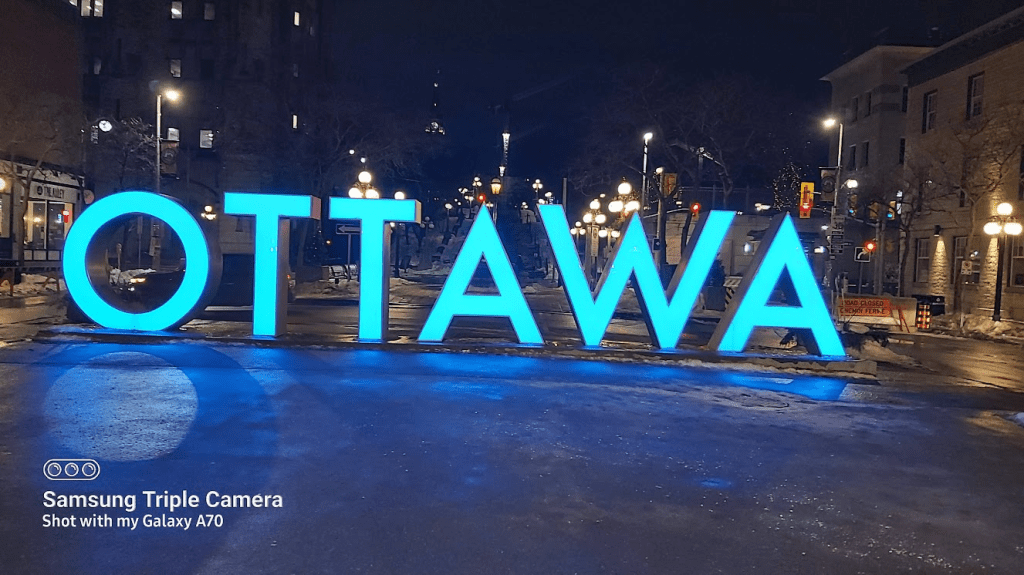
This was my second trip to the nation’s capital, and both times it was to participate in a protest against the government. My first trip to Ottawa was for the Veteran’s Mefloquine Rally on Parliament Hill in September 2019, during which temperatures were in the high 20’s to low 30’s Celsius. I would like to make another trip there someday, only as a tourist next time, not as part of a protest. Ottawa isn’t only home to many of Canada’s historic places and our seat of government, but it is also known for its many pubs and restaurants that are worthy of a visit, and I was able to take in a couple of them while I was there.

I have no quarrel with you.

I can understand the anger and frustration felt by many of you, especially those living and working in proximity to Parliament Hill. However, I believe that sometimes events such as this will come with the territory whenever anyone lives in a national capital, no matter what country you live in. I would suggest that anger and frustration also be directed towards the Trudeau regime, as it was their actions that were responsible for pissing Canadians off to the point that they decided to say “enough”, bringing them out in numbers never seen before in this country.

A moment in history.

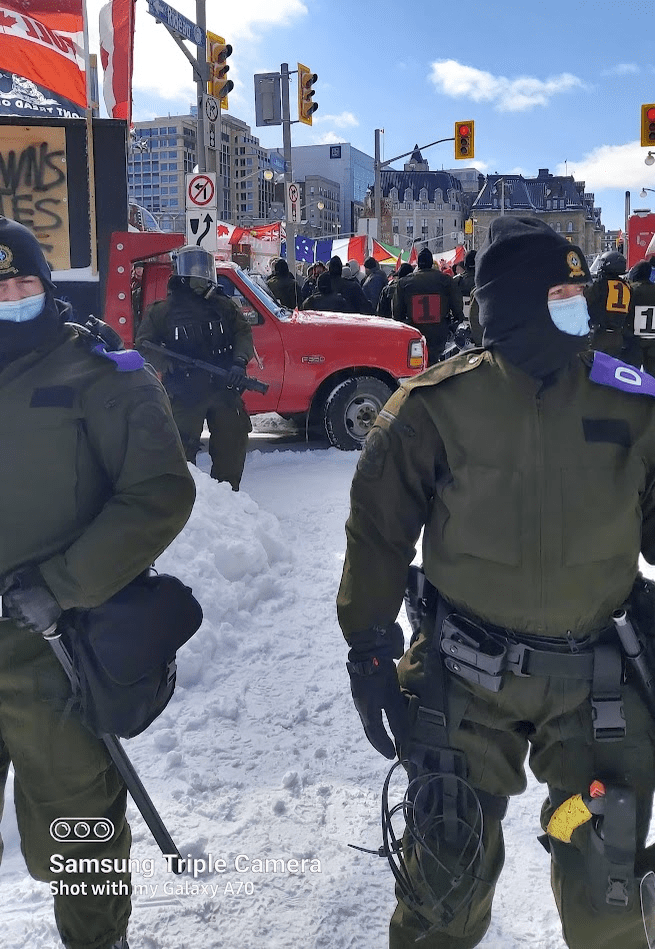
For a week in 2022, I joined hundreds of thousands of other Canadians who had made their way to the nation’s capital in unprecedented numbers, and it was an adventure that will remain forever in my memory. I had the chance to meet and talk to some of those people and to see some of the places made (in)famous in Canadian political lore. I stood in solidarity with veterans as they kept watch over the National War Memorial and Tomb of the Unknown Soldier. I would also come face-to-face with the Sûreté du Québec’s Tactical Intervention Squad, helping to hold the line against them as they began to move in on protesters. By the end of that week, I had walked more than 80 km (50 miles), more than I had walked in the previous 6 months combined.

Between now and February 18th, I will recount the story of my adventure in words and with the images and video I captured during this once-in-a-lifetime moment in Canadian history. Join me as I share with you my firsthand account, and provide you with my take on the events of those seven days in Ottawa.