Prošle godine imao sam priliku biti u Ottawi na trećem godišnjem veteranskom mitingu meflokvina i imao sam čast predstaviti Marja Matcheea, pokretačku snagu skupa i dugogodišnjeg zagovornika meflokvina. Bila mi je to prilika za pamćenje i imao sam priliku prvi put osobno upoznati mnogo ljudi i radovao sam se ponovnom sudjelovanju sljedeće godine.
Stvari su se od prošle godine puno promijenile i kao rezultat toga miting se više nije mogao održavati u Ottawi. Nespreman zbog toga, Marj je krenuo u sastavljanje novog plana. Bit će još jedan skup, u Edmontonu, i ona će biti tamo da se bori i zagovara one kanadske veterane i njihove najmilije čiji su životi uništeni zbog meflokina.
Ali Edmonton neće biti jedino mjesto koje će održati miting, jer će ga također biti u Kingstonu, također u Ontariju. Može se dogoditi i u Novoj Škotskoj. Gdje god se nalazili u Kanadi ili svijetu, ako želite dati izjavu o meflokinu, ovo bi bila izvrsna prilika za to. Ne morate održavati skup, iako ako ste u mogućnosti organizirati ga na bilo koji način.
Svrha
Kao i uvijek, svrha skupa je poziv vladi Kanade:
Da biste ponovo otvorili istražnu komisiju u Somaliji.
Priznati one čiji su životi oštećeni uslijed naređenja da uzmu meflokin.
Da se stave na raspolaganje sredstva za istraživanje lijeka i kako bi se stavili na raspolaganje medicinski resursi pogođenim braniteljima.
Za one koji žive izvan Kanade ovo bi bila odlična prilika za povećanje svijesti o meflokinima u vašim zemljama, a istovremeno ćete pozvati svoje vlade da poduzmu akciju i po ovom pitanju. Tisuće veterana širom Europe vjerojatno pate jer im se dogodilo i ista stvar. Napori za zagovaranje u Irskoj i Velikoj Britaniji daju glas tamošnjim braniteljima, ali isto se ne može reći za kontinentalnu Europu gdje su stope PTSP-a i samoubojstava među braniteljima tijekom godina naglo narasle.
#Veteransmefloquinerally2020
I dalje možete pokazati svoju podršku i napraviti promjene bez održavanja skupa. Gdje god da se nalazite u svijetu 19. rujna, fotografirajte sebe kako držite znak s hashtagom # Veteransmefloquinerals2020 zajedno s lokacijom na kojoj se nalazite, i objavite je na Facebook stranici Veteran’s Mefloquine Rally 2020 klikom na donju vezu i zatim „Rasprava“ na samoj stranici. Ni to ne mora biti veliki znak, čak će to i ispisati na papir s Sharpieem.
U subotu, 19. rujna, ma gdje bili u svijetu, odvojite malo vremena da pokažete svoju podršku onim veteranima koji su za njihovu uslugu platili vrlo strmu cijenu, a vladama dajte do znanja da će biti odgovorni za svoje radnje.
Saturday, September 19th #Veteransmefloquinerally2020
3rd Annual Veteran’s Mefloquine Rally in Ottawa 2019
Last year I had the opportunity to be in Ottawa for the third annual Veteran’s Mefloquine Rally and had the honour of introducing Marj Matchee, the driving force behind the rally and long time mefloquine advocate. It was a memorable occasion for me and I had the chance to meet a lot of people in person for the very first time, and I was looking forward to attending again the following year.
Things have changed a lot since last year and as a result the rally could no longer be held in Ottawa. Undeterred by this, Marj set about putting together a new plan. There will be another rally, in Edmonton, and she will be there to fight and speak up for those Canadian veterans and their loved ones whose lives have been destroyed because of mefloquine.
But Edmonton won’t be the only place that is having a rally as there is also going to be one in Kingston, Ontario too. There may also be one taking place in Nova Scotia as well. Wherever you are in Canada, or the world for that matter, if you want to make a statement about mefloquine this would be a great opportunity to do so. You don’t have to hold a rally, though if you are able to organize one by all means do.
Purpose
As always the purpose for the rally is to call for the Government of Canada:
To reopen the Somalia Commission of Inquiry.
To acknowledge those whose lives have been damaged as a result of being ordered to take mefloquine.
To make funding available for research into a cure and in order to make medical resources available to veterans who have been affected.
For those who live outside of Canada this would be a great opportunity to increase mefloquine awareness in your countries while calling on your own governments to take action on this issue as well. Thousands of veterans across Europe are likely suffering because the very same thing happened to them too. Advocacy efforts in Ireland and the UK are giving voice to veterans there, but the same cannot be said for continental Europe where rates of PTSD and suicide among veterans has skyrocketed over the years.
#Veteransmefloquinerally2020
You can still show your support and make a difference without holding a rally. Wherever you are in the world on September 19th, take a picture of yourself holding a sign with the hashtag #Veteransmefloquinerally2020 along with the location that you are at, and post it on the Veteran’s Mefloquine Rally 2020 Facebook page by clicking on the link below and then “Discussion” on the page itself. It doesn’t have to be a big sign either, even writing it out on a piece of paper with a Sharpie will do.
On Saturday, September 19th, wherever in the world you may be, take a little bit of time to show your support for those veteran’s who paid a very steep price for their service, and to let governments know that they will be held accountable for their actions.
The decisive final one hundred days of World War I and the important role played by Canadian Corps.
26/27 August – The Battle of the Scarpe begins.
Arthur Currie’s plan for the beginning of the battle was to rain down massive amounts of artillery on the well dug in enemy in order to soften them up for the attack. At 3am, as a light rain came down, it began and caught the Germans completely by surprise. Two Canadian divisions and one British division were able to advance forward over 5km and by the end of the day the villages of Monchy, Guemappe, and Wancourt were in Allied hands.
The weather would play a factor on the 27th as heavy rains slowed down the advance and made for difficult conditions under which to engage the enemy, and thus would advance little more than 3km on that day.
Mechanized infantry was still in its infancy and mounted cavalry units were used regularly on the battlefield, but so were bicycles. In fact, there were battalions of soldiers on bicycles and their use would continue in the Second World War.
A Canadian cyclist shouting down a German dugout during the 2nd Battle of Arras. The first phase of the battle was an unmitigated success for Canadian troops, who encountered only little resistance from enemy defence positions. Cyclist battalions, as well as the cavalry, still played an important role at a time when efficient mechanized means of transportation were still being developed. Library and Archives Canada. Department of National Defence Collection 1964-114 PA-003071
Victoria Cross awarded to Lt. Charles S. Rutherford – Captured over 70 prisoners and neutralized enemy machine guns, without firing a shot.
Lt. Charles Smith Rutherford
Lt. Charles Rutherford of the 5th Canadian Mounted Rifles Battalion was awarded the Victoria Cross for his actions on 26 August in Monchy-le-Preux while leading an assault party. Scouting ahead of his troops by some distance he saw some Germans standing near a pillbox. They motioned to each other, with Rutherford approaching the Germans, revolver in hand. He was able to convince them that they were surrounded, leading to the surrender of 45 men including 2 officers. He was then able to convince one of the German officers to order a nearby machine gun to cease fire, allowing his own men to advance toward him.
Rutherford then moved on to another pillbox, assaulting it with a Lewis gun section and convinced a further 35 Germans to surrender as well as capture a machine gun.
Sources
The 2nd Battle of Arras – Library & Archives Canada
The decisive final one hundred days of World War I and the important role played by Canadian Corps.
12-25 August – Holding off attacks and drawing up battle plans.
Special thanks to University of Calgary history professor Dr. David Bercuson.
Canadian troops shelter in a ditch along the Arras-Cambrai road.
While performing dangerous clean up operations after the battle, contact with enemy troops resulted in another two Victoria Crosses awarded to Canadians for actions on August 12th and 13th.
Pte. Thomas Dinesen, 42nd Battalion, 3rd Canadian Infantry Division
Sgt. Robert Spall, Princess Patricia’s Canadian Light Infantry, 3rd Canadian Division
By the 20th of August, the Canadians had advanced more than 22km capturing more than 9,000 enemy prisoners, as well as a large number of weapons along the way. There are some 11,800 casualties up to this point from the 8th of August.
On August 22nd Lt.Gen. Sir Arthur Currie outlines his plans for an attack to the east in Arras. It is to be known as the Battle of the Scarpe and is set to begin four days later on the 26th.
Arthur Currie – From boyhood to the beginning of the war.
Anonymous – Archives of Strathroy Museum A 1919 photograph of the farm homestead of Arthur Currie, located near Strathroy, Ontario, Canada. The photograph was taken on the occasion of his homecoming, following the First World War. The house eventually fell into disrepair, and was demolished in 2016.
Arthur William Curry wasn’t born into the officer class or aristocracy of the late 19th century. He was born on his grandfather’s humble homestead farm on the 5th of December, 1875. It was a strict Methodist household he grew up in, the third of eight children, but revealed his sense of humour and an infectious laugh at school. He proved to be a good student and had convincing oratory skills which had many believing he should pursue a career in law or perhaps medicine.
His family was of modest means however and after his father died in 1891 he would attend teachers college in Strathroy earning a third-class teacher’s certificate. Finding little luck finding work he went back to school in an effort to get an honours certificate so that he could gain entrance to university. He would leave the school before graduating amid rumours of a dispute with one of his instructors and in May of 1894 he made his way west in the hopes that fortune awaited him on the coast of British Columbia. The building of the transcontinental railway had resulted in a construction boom and Curry had hopes of cashing in.
It wasn’t long before he realized that the opportunities he had been dreaming of were not to be found and so he would have to rely on teaching to earn a living. After receiving his British Columbia certification he landed a job teaching on Vancouver Island and it was there in May of 1897 that he joined the Canadian Militia. He started at the lowest rank, gunner, in the 5th (British Columbia) Field Artillery Regiment.
It was also in 1897 that he would change the spelling of his name to Currie, the rumour being that he didn’t like being the object of jokes about spicy Indian food. He continued to teach and work part-time in the militia but he was becoming increasingly dissatisfied with his prospects as a teacher, and in 1899 stomach issues left him briefly hospitalized. After this, he decided to abandon teaching and try his luck as an insurance salesman in Victoria.
In 1900 Currie was promoted to corporal and had so impressed his superiors that he was being offered a commission. This would certainly be a great move for him as it would begin to open doors for him within society circles, however, there would be costs involved. Among other things officers were expected to provide their own tailored uniforms, not to mention the fact that he was engaged to be married. These things would provide the impetus for Currie to succeed in the insurance business and he did in fact succeed, taking over the insurance business he worked at in 1904.
He worked hard at both pursuits, becoming established within the local business community and making a name for himself while taking whatever courses were available to him in the militia and would read whatever he could in an effort to advance his military career. By 1909 Currie had been promoted to Lieutenant Colonel and was now in charge of the regiment he had joined only a dozen years before as a gunner.
His business prospects were starting to take off as well. In 1908 he partnered with another local businessman, R.A. Power, to form a venture called Currie & Power. Seeking to take advantage of a real estate boom Currie invested heavily in speculating on the market, with the business initially proving to be a success. But in 1912 the real estate market began to soften and Currie soon found himself in deep financial trouble. In 1913 the market collapsed and Currie was facing the prospect of having to retire from the militia due to his age.
It was around this time that he was offered the command of a newly formed regiment, the 50th Regiment (Gordon Highlanders of Canada). In addition to having to plan and organize its formation Currie would have to foot the bill for the regiment’s uniforms along with other expenses. Ultimately the government would allocate funds for new uniforms in the amount of $10,833.34, however, Currie was still in a state of financial crisis. He was facing the prospect of having to declare personal bankruptcy, a move which would see his militia career end in disgrace and leave his social status in ruins. Currie would spend the money but not to buy the uniforms. Instead, he diverted the proceeds into his own account and used the funds to pay off his own personal debts.
At the time he did this, Currie had been under the impression that the regiment was going to be underwritten by the Gordon Highlander’s honourary colonel, William Coy, to the tune of $35,000. Currie had anticipated that he would be able to cover the funds he had embezzled using these proceeds. Unfortunately for Currie, Coy didn’t honour his commitment and it was likely only a matter of time before his creative accounting scheme was uncovered.
The man serving as Currie’s third in command of the “Gay Gordon’s” as they were called was Garnet Hughes, who also happened to be the son of the Minister of the Militia in the Borden government, Sam Hughes. Having seen the younger Hughes in action Currie concluded that although he was a good and capable cadet Garnet Hughes was incompetent and not fit for military command.
Meanwhile, when war broke out the senior Hughes began handing out plum command positions within the 1st Division and he would offer Currie, his son’s CO, command of the 2nd Brigade. Although he considered it, Currie decided that it would be best to remain in Victoria in order to address his dire financial situation. But he would later change his mind after he was approached by Garnet Hughes, who convinced him to accept the position. Currie was promoted to Brigadier General in late September of 1914 and soon after left for England with the rest of the 1st Division.
Around the time that Currie was arriving in England, the details of his embezzlement scheme had become known to Prime Minister Robert Borden. Rather than recalling the Brigadier back to Canada, Borden instead chose to do nothing.
This struck me as odd since Currie was an unknown at that time and had no battlefield experience which might influence Borden’s decision. I talked with University of Calgary history professor Dr. David Bercuson, an expert in Canadian military history, to see if perhaps he could shed some light on this. Despite looking through Borden’s diaries and papers extensively he could find no mention of this. He did offer me his theory though and he believes that it was because Borden trusted Sam Hughes to do the right thing. He may have thought that Hughes had known about the embezzlement and promoted him anyway. It’s speculation and we will never really know but this explanation is the most plausible.
Awe inspiring memorial the reason behind “Exercise Freedom Together”.
fieldofcrosses.com
As we near the last bit of the dog days of summer, Remembrance Day is probably one of the farthest things on most of our minds. Yet, for some it is very much at the forefront. For them it is the culmination of a commemoration of remembrance that starts at the beginning of November and runs until the 11th. They are the many men and women involved in the Field Of Crosses Memorial Project in Calgary.
fieldofcrosses.com
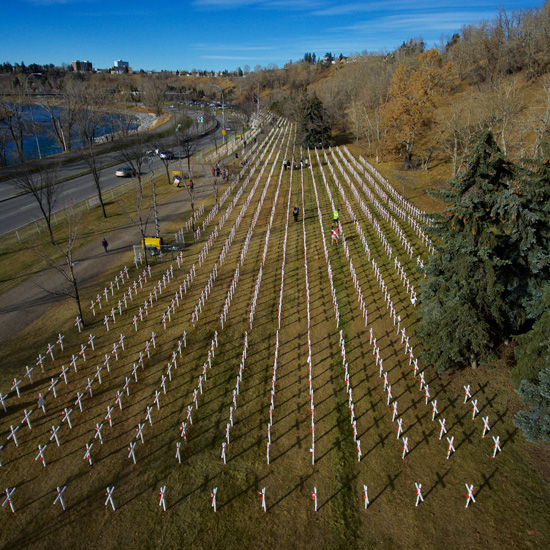
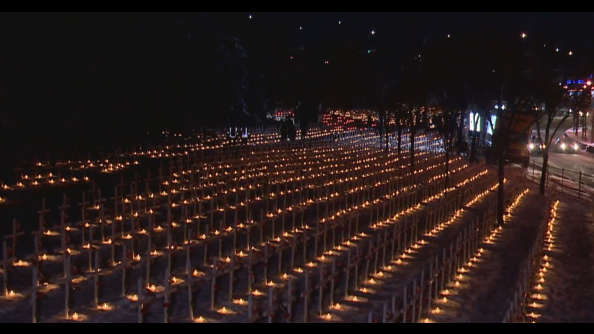
Every November since 2009 over 3,500 white crosses have been popping up on a clearing along Memorial Drive here in Calgary, the thoroughfare named in honor of those from Southern Alberta who perished in the Great War of 1914 to 1918, better known as World War One. After the war a plan was made to have a living memorial to those fallen, and between 1922 and 1928 3,278 trees were planted along Memorial Drive. The majority of them were poplar trees which are now at or near the end of their natural life cycles and will be replaced by a number of different tree species.
Calgary Herald
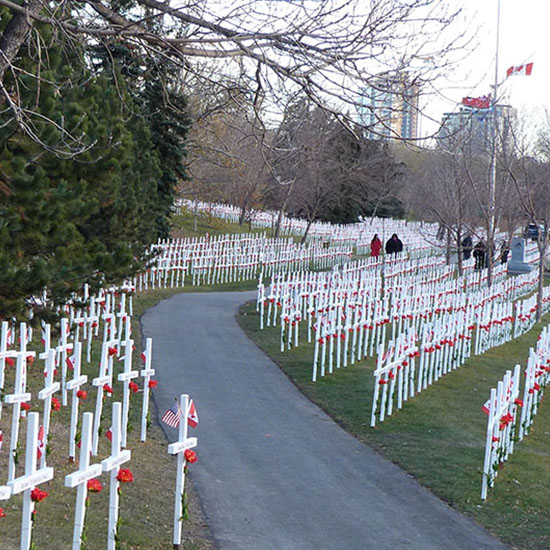
The crosses stand on a two hectare parcel of land on the north side of Memorial Drive not far from the Centre Street bridge. Some 3,500 stark white crosses, each representing a military service member from Southern Alberta who gave their life in service to their country. These were men and women from Calgary, Lethbridge, Medicine Hat, and numerous other communities who answered the call of duty and made the ultimate sacrifice for their country. Navy, army and air force personnel from the Great War to Afghanistan including our fallen peacekeepers are memorialized here.
Sunrise and sunset ceremonies
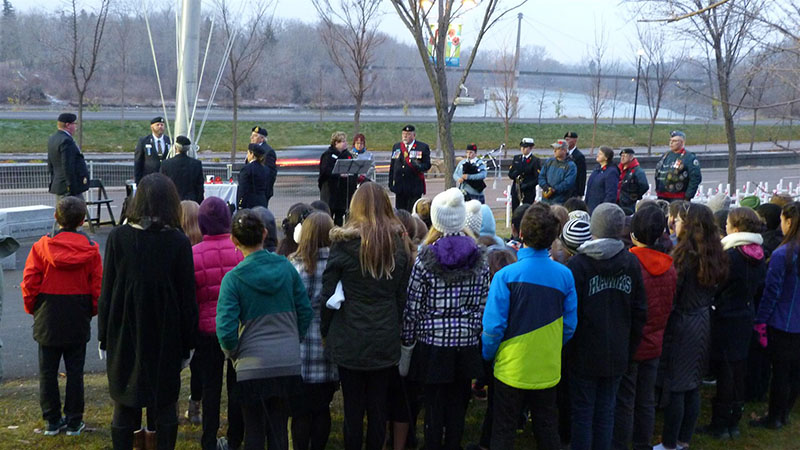
Beginning on the first day of November and going everyday until the 11th solemn ceremonies are held at sunrise and sunset according to tradition, with a flag raising ceremony at dawn and a flag lowering cermony at sundown. For schoolchildren the sunrise ceremony is an excellent way for them to learn about the history of this country and the significance of Remembrance Day. Many field trips have taken place here since the memorial began.
Sunrise Ceremony 2015
A sunset ceremony is particularly poignant as the field is illuminated with nearly 3,500 candles, one placed in front of each cross and lit by a group volunteers. It is one of those scenes that can leave a person awestruck. Not only is it something to behold it also serves to remind us that there is a life that has been lost for each candle, a life with a story of their own, a life cut tragically short.
Courtesy MSN
Inspiration
Courtesy Veteran’s Affairs Canada
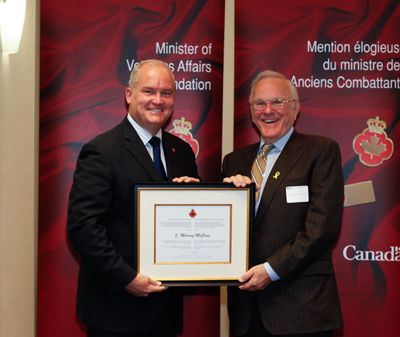
It was Calgary businessman and philanthropist Murray McCann who had the vision for the memorial. His inspiration came while driving through the southern US state of Georgia where he encountered a roadside memorial of crosses in the small town of Menlo. Residents of the town had put them up to honour those from their midst who had died in service to their country. When he returned home he told his friend, Calgary Poppy Fund president and navy veteran George Bittman, about his plan to put up a memorial to southern Alberta’s fallen. Together they were able to put up the first memorial in 2009. George Bittman was tragically killed in an accident in 2012 but McCann vowed to carry on in George’s spirit.
The philanthropist wanted to make sure that this memorial would outlive him in perpetuity, and in 2019 the Field Of Crosses Memorial Foundation was granted status as a registered charity.
#Exercisefreedomtogether
This year the foundation has launched its fundraiser which it has called Exercise Freedom Together. It’s an invitation for Canadians to celebrate the freedoms for which our fallen military service members have made the ultimate sacrifice, while enjoying some exercise in the company of others. It is a challenge to walk, run, or bike 3k and post a photo of you or your squad, with your hand on your heart if possible, to Facebook and/or Instagram (or other social media) using the hashtags @Exercisefreedomtogether or #Exercisefreedomtogether. Individual participants are asked for a donation of $5 and “squads” (groups of up to 5) donate $25.
More importantly however they are asking that you challenge others to do it as well. The goal is to raise $150,000, so the more people that hear about Exercise Freedom Together the better. Form a squad with your friends or your coworkers and challenge others to get out and walk, run, or bike 3k for the Field Of Crosses Memorial Foundation.
100 days from 8 August 2020 – 11 November 2020
The campaign is running for one hundred days beginning on August 8th and ending on November 11th, 2020. This is to comemmorate the period of World War I known as The Last Hundred Days, which was the last 100 days of the conflict. During that time the Allies made huge advances against the Germans, winning a number of important battles, and the Canadian Corps played a significant role in it led by Lieutenant-General Sir Arthur Currie who is considered to be one of the best field commanders not only in the Canadian army, but of all time.
The cost of these victories was enormous on all sides with tens of thousands of soldiers killed, wounded, or missing in action. The Canadian Corps suffered over 45,000 casualties during the last hundred days. To put this into perspective Canadian troops first saw action in April of 1915 meaning that they would begin to see casualties at this point. Of the total number of Canadian casualties at the end of the war one fifth, or 20%, occurred in the last one hundred days.
Across the country
From its inception in 2009 the Field Of Crosses Memorial has been unique to Calgary, but the Foundation would like to see it spread to other communities accross the country. It is an incredibly poignant way to honour those who have fallen, particularly in communities that do not already have permanent memorials.
So what would it take? To start with, an individual or group who would be willing to dedicate the time and effort that it would take to do it and a list of the fallen from your community. For more information you can contact Major (retired) Kent Griffiths from the Field Of Crosses Memorial Foundation.
The final one hundred days of World War One was marked by a series of important Allied victories, and Canadian Corps would be leading the way.
The Battle of Amiens 8 August 1918 – 11 August 1918
Canadian soldiers on the battlefield of Amiens, France, during the Hundred Days of 1918 — the last 100 days of the Second World War. CANADIAN WAR MUSEUM/POSTMEDIA NEWS
The 8th of August marked an important day in Canadian history. August 8th, 1918 was the beginning of the final one hundred days of World War One, a period which is highlighted by a number of key allied victories against the Germans. Canadian troops would go on to play a pivotal role at this time, and it would also be when they would become feared by the enemy for their savagery. It is often said that Canada became a country after the Battle of Vimy Ridge in April of 1918, and if this is the case then the last 100 days are when we started to form an identity. The effort would prove costly however as Canada would suffer over 45,000 casualties, an incredible 20 percent of the overall total, during those final bloody days of the “War to end all wars”.
Those final days also saw many acts of incredible bravery and heroism by soldiers of the Canadian corps. Out of the 64 Victoria Crosses that were awarded to Canadians during the first world war almost half of them (30) were awarded during those last one hundred days.
The attrition of trench warfare
Prior to World War I, wars were essentially fought the same way. Two armies would meet on the battlefield and would fight in full frontal clashes much in the way it had been done in the Roman era. There was artillery of one form or another as well as mounted cavalry elements, but for many hundreds of years throughout history battles essentially all looked alike. Masses of troops converged together to fight it out until there was a winner and a loser, inevitably resulting in the loss of an incredibly large number of men on both sides. There was something of a chivalric code of honour that ruled warfare and this continued on into the Great War.
The net result would be millions of men dead in a war that had seen neither side make any significant gains. It was the conflict that ushered in the modern era of weaponry as the machine gun, the tank, poison gas, and high explosive artillery, were introduced to the field of battle. Yet for all of this, the tactics that were employed were anything but modern and would result in carnage on a monumental scale.
The Canadian Corps
When Great Britain declared war on Germany in 1914 it automatically meant that Canada was too since Canada was then a Dominion of Great Britain. Canadian troops were part of the British Expeditionary Force (BEF) and were placed within British units under the command of British officers. At the outset of hostilities, the British were confident that the war would be short even going so far as to say that it would all be over by Christmas. But as the war continued past 1915 it was becoming more apparent that there would be no easy victory any time soon.
By this time political pressure was beginning to mount in Ottawa to have more autonomy from Great Britain, especially as far as the Canadian Corps was concerned. When it was formed in 1915 it was commanded by Gen. Sir Edwin Alderson then taken over in 1916 by Gen. Sir Julian Byng, who would later go on to become the Governor General of Canada. The pressure was its highest following the Battle of the Somme, which lasted from July 1st until mid-November and saw thousands of Canadians killed, wounded, or missing in action.
Canada was beginning to assert itself as a nation within the British Empire, and if its sons were going to be sent off into harm’s way, then it should have more of a say about it. As a result, in 1917 the Canadian Corps was placed under the command of Gen. Arthur Currie and the rest as they say is military history.
General Sir Arthur Currie
Arthur William Currie was born on December 5th, 1875 on a farm near Napperton, Ontario. His career began as a part-time citizen soldier in the militia in 1897 as a gunner while also working jobs as a teacher and later selling insurance as well as being a speculator in real estate. In 1900 he received his commission and began to rise quickly through the ranks, achieving the rank of Lieutenant Colonel in 1909. In September of 1914, a month after war was declared, Currie was made a Brigadier General and placed in command of the 2nd Canadian Brigade.
By the end of the war, he would be the commander of the Canadian Corps and knighted by King George V. As I write about the hundred days I will also be telling the story of the man considered to be one of the best field commanders of World War I and perhaps in history.
The Battle of Amiens
Early in the morning of August 8th, the Allies began their attack behind a creeping barrage of artillery. By the end of the day, French and Australian troops spearheaded by the Canadian Corps had made the greatest advance of the entire war to that point, moving 13 kilometres across a 20 km line and catching the Germans completely by surprise. More than 5,000 were taken prisoner and they would 161 guns. General Erich von Ludendorff called it “the black day for the German army in the history of this war”, and it would deal a demoralizing blow to German troops.
The plan called for the Germans to be deceived into thinking that the Canadians were someplace that they weren’t in order to catch them by surprise. Detachments from two infantry battalions, a wireless unit and a casualty clearing station, were sent to the front near Ypres while making an effort to ensure that the Germans saw them as they did so. They would then surreptitiously return to their units which were being sent to Amiens secretly.
Four Canadians would distinguish themselves that day and be awarded the Victoria Cross.
Cpl. Harry Garnet Bedford Miner, 58th Battalion, 3rd Canadian Infantry Division
Pte. John Bernard Croak, 13th Battalion, 1st Canadian Infantry Division
Cpl. Herman James Good, 13th Battalion, 1st Canadian Infantry Division
Lt. James Edward Tait, 78th Battalion, 4th Canadian Infantry Division
9 August, Day 2 Battle of Amiens
Another hard-fought day as the Corps advance another 6.5 km and suffered over 2,500 casualties. Four more Canadians earn the Victoria Cross.
Lt. Jean Brillant, M.C., 22nd Battalion, 2nd Canadian Infantry Division
Sgt. Raphael Louis Zengel, M.M., 5th Battalion, 1st Canadian Infantry Division
Cpl. Frederick George Coppins, 8th Battalion, 1st Canadian Infantry Division
LCpl Alexander Brereton, 8th Battalion, 1st Canadian Infantry Division
10-11 August, End Battle of Amiens
The battle officially ends on August 11th after three German counterattacks are held off.
Australian SAS war crimes in Afghanistan and their subsequent cover up playing out like a Joseph Conrad novella.
If you are of a particular age you have likely seen the movie Apocalypse Now, or have at least heard of it. Francis Ford Coppola’s screen epic was his modern day take on the Joseph Conrad novella Heart Of Darkness, which was first published in 1899. First released in 1979, it was re-released in 2001 as Apocalypse Now Redux with an additional 48 minutes of footage not in the original. If you haven’t seen it yet and think you might want to in the future I recommend watching this version.
A brief synopsis.
Setting
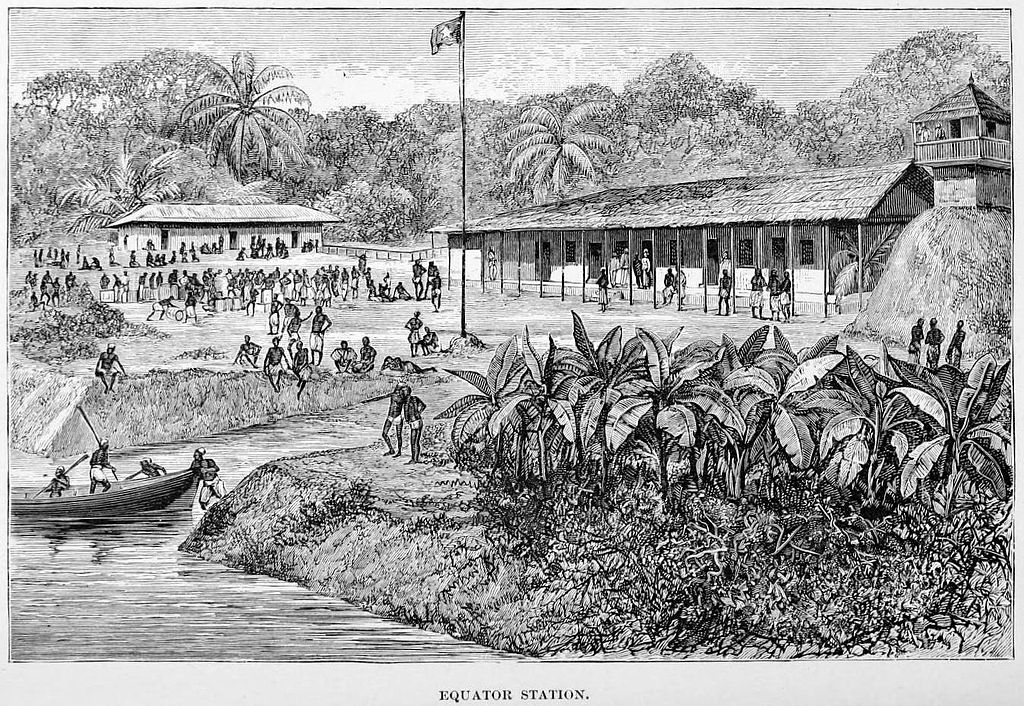
Whereas Apocalypse Now is set in the jungles of South East Asia during the Vietnam War, Heart Of Darkness plays out in the heart of what was referred to back then as deepest, darkest Africa at the dawn of the ivory trade in the late 19th century.
Characters (protagonist(s)& antagonist(s))
Heart Of Darkness is a story told by the protagonist, Charles Marlowe, who has lived his life at sea. He recounts of a job he once took for a company that exported ivory which would take him up the Congo river to pilot one of their boats out of a remote station deep in the jungle. Along the way he hears about an agent named Kurtz whose praises are sung by all. He’s their top producing agent and sells more ivory than all of the other agents combined and is highly prasied by all.
In Apocalypse Now the Marlowe character is replaced with Martin Sheen’s Capt. Benjamin Willard, who has been called back to Saigon for a special assignment. It is Willard who serves as the narrator of the story. Kurtz is now Col. Walter E. Kurtz, special forces commander and young rising star, played hauntingly by Marlon Brando.
Key Plot Moments
Heart Of Darkness
The company that hired Marlowe is curious to know how Kurtz is able to acquire the fantastic amount of ivory that he does, and so sends some men out to investigate. They ultimately come to find out that when Kurtz first arrived he had encountered a primitive tribe living in the forest. Ever the good Christian Englishman, Kurtz made an attempt to civilize this group he saw as savages and was encountering a bit of difficulty in doing so. In an effort to try to get through to the tribesmen better Kurtz decides to try to approach them on their own level, and ultimately begins dressing and acting like a savage himself. He begins to employ their methods, and in doing so is not only accepted by them but revered as a god, while his employers are aghast at his methods. Finding these methods to be “unsound” they set out to have Kurtz killed, though it is moot since Kurtz is already gravely ill and ultimately dies before anyone could murder him.
Apocalypse Now
Captain Benjamin Willard has been sent to Saigon on a top secret assignment. He’s summoned to a meeting with a general and a member of the CIA where he is told about Colonel Walter Kurtz’s past and his present situation. Col. Kurtz has gone rogue, having become revered as a god in the same way as the othe Kurtz, and the men who created him now want his command to be “terminated with extreme prejudice”. As a matter of reference this is, as far as I know, the first mention on film of the phrase “terminate with extreme prejudice”, which became popular in the 80’s and thereafter. I won’t go any further so as to not spoil things for those who might want to watch it later.
Examination of morals
Both stories take a deep look inside the psychology behind the behaviour of the characters and in each case, the creators of the “monsters”, for lack of a better word, acknowledge that they have created a monster albiet inadvertantly. The company, or government as in Apocalypse Now, then takes action to eliminate Kurtz out of a sense of fear but also does so perhaps with a sense of morality behind it. Aside from the fear of being found out, they needed to put a stop to the creature they helped to create and set loose into the world lest it do any more damage.
A contemporary interpretation based on real events.
Over the last several months I have improved my skills as a writer and have received positive reviews and feedback from those who have read my stuff. Saying this, I by no means think of myself as being in the same company as Joseph Conrad or Francis Coppola, but I can’t resist taking a crack at my own attempt at an interpretation of this story, with a rather important twist to it however, as you will see. This stuff really does write itself sometimes.
This is a story in real time, the end has not been written yet. The characters and events are real. As always bear in mind that real life can often be much stranger than fiction.
The title – Soul Of Darkness
The way I see it, this tale can be viewed from a couple of different lenses. It can seen as an interpretation of the original story or, as another part to it like a sequel. In calling it Soul Of Darkness I’m leaving the door open to a lot of things and allowing the reader to view it in what ever way they wish.
Setting
The story primarily takes place in wartorn Afghanistan in the years 2011 and 2012, although Australia is also the backdrop for a portion of it. Events that took place in the villages of Sarkhoum and Darwan will make these places of great significance to this story.
Characters
The protagonist of this story, the Charles Marlowe/Capt. Willard if you like, is Australian Defense Force whistleblower David McBride, whose story I have been following for over a year. He is currently on trial in an Australian court after he released an unknown number of classified government documents to the newsmedia, and faces decades in prison for his actions. Some of these documents revealed that members of the elite Australian SAS had committed war crimes while in Afghanistan.
There is no single Kurtz character playing the antagonist here however, as individual SAS members and teams play a part in this but so do their commanders on the ground as well as high level officers and ministers within the Australian government. Men like Generals Angus Campbell, David Morrison, and the current Governor General of Australia David Hurley. Perhaps the one who would personify it best however would be an individual known only as “Soldier B”, who was awarded the Victoria Cross in 2016 under dubious circumstances.
Plot
McBride tells us the story of soldiers who have gone rogue and committed horrific acts that are with absolutely no question war crimes. Remember that Major McBride is a highly talented attorney, expert in international law and the laws of conflict. When he tells you that something is a war crime you can take it to the bank that it is one. He was a legal officer in Special Operations Command and he’s talkimg about the war crimes that he’s aware of and that weren’t acted upon at the highest of levels. In fact the officials in the Ministry of Defense and other senior officials had knowledge that these acts were occurring and did absolutely nothing about it, other than act to cover them up and keep them out of the public eye.
David McBride’s YouTube Channel – David McBride Trial
McBride has been telling his story on his YouTube channel he created a little less than a year ago. David McBride’s Trial begins with him discussing his case and making an appeal for donations to a legal defense fund, then trails off until about a month ago, early July, when he began making videos again. This time he is beginning to tell us what he knows about the war crimes that were committed by certain elements within the SAS. It’s important to note that this behaviour is not reflective of a majority of the men there and that these were indeed rogue elements within the storied elite special forces regiment.
Names places and incidents.
In an incredible series of videos made between July 5th, 2020 and August 6th, 2020, McBride tells a gripping story that is at times difficult to hear but must be heard. He begins by telling of the status of his case, which is currently on hold as prosecutors consult with the Americans about the case. Yes, the Americans. Our Five Eyes ally knows about this case and now has influence over a criminal trial in Australia, another Five Eyes ally, yet this influence isn’t reciprocal. This surprises me not.
As he proceeds further though things begin to on a somewhat darker tone. Now is where we begin to hear about the incidents that he is privy to, the ones in the documents he leaked to the press, the ones where criminal acts, atrocities, have been committed. The names of two villages emerge, Sarkhoum and Darwan. Things happened there, terrible things, and lies were told in after action reports to cover them up. An alleged Taliban killed in an exchange of fire is in actuality an innocent civilian, taken prisoner and then kicked to death after being seen by a medic. The perpetrator, a member of the SAS who would recieve the Victoria Cross for actions while in Afghanistan. A hero who won perhaps the most prestigious award for gallantry and bravery in the world, is a cold-blooded murderer. In another incident that took place on September 11, 2012, a prisoner was thrown off a cliff by this man who would then order an Afghani soldier to shoot the prisoner as he lay on the ground in a crumpled heap.
It again must be said that these incidents were the exception and that the vast majority of operators in Afghanistan acted professionally and with honor in accordance with ancient laws and traditions of warfare. But none of them were awarded for their actions as much as “Soldier B”. McBride’s message to those in the SAS who may be upset that he’s talking is this, “Get over yourself”. He went to the wall for the SAS as a legal officer but these are war crimes and he simply will not abide that.
It was all captured on video
There were drones in the sky keeping watch over every mission that special operators conducted, including the SAS. All of the incidents that occurred would have been seen by those on the ground and the information passed along up the chain of command. The men in charge knew exactly what was going on. Men like Angus Campbell who was promoted to Major General and given command over all Australian forces in Afghanistan in 2011. He would later go on to become Chief of the Army and is the current Chief of the Defense Staff.
David Hurley was the CDS in 2011 and as such is also implicated in this. Not a very good look for a man who is currently the Queen’s representative in Australia, the Governor General. You would expect that the vice-regent would be of somewhat higher quality, however this is not exactly a position known to be filled by the best of people and this applies anywhere in the commonwealth. Canada would be a perfect example.
There is no way they couldn’t have known what was going on, they were the men in charge. The footage from the drones and from the bodycams of the operators would be there for all to see. What they did was morally and etically reprehensible and also legally wrong. If the Yamashita Standard is applied, they should be facing trial in International Criminal Court.
The Yamashita Standard
General Tomoyuki Yamashita commanded Japanese forces in Singapore during World War Two and was charged with war crimes. By all accounts General Yamashita was an good and honourable army officer, and was not a fanatical follower of the emperor. Troops under his command committed war crimes and atrocities which he claimed at trial to have absolutely no knowledge of. The prosecution asserted that as their commander Yamashita was responsible for the actions and conduct of his troops whether he was aware if it or not. He was subsequently found guilty and hanged in 1947.
Australia has jurisdiction
It is worth noting however that the ICC would not become involved unless and until Australia failed to act on the matter on its own first. So now it will be up to the Generals’ masters to decide their fate, and this does not give one much comfort that much will be done about it. Those politicians and nabobs in Canberra will dither and drag things out, trying to keep this out of the light as much and for as long as possible in the hope this eventually dies of natural causes. But it won’t, too many people know too much now. Information is starting to see the light of day and public scrutiny, and there is much, much more to come.
Examination of morals
The fear and morality that motivated the termination of Kurtz in the first two stories is absent here. Now the government, aware of the monster, does nothing to stop it. It will in fact attempt to benefit from the monster and it’s actions. It is completely bereft of morality and humanity and if the heart of darkness beat in the previous two charcters then what we see now is in fact the very soul of darkness. Pure evil and malevolence personified in the form of a nations politicians and military leaders. It is a nightmare come to life in an all to real manner.
So much more to tell, you need to see the videos
For the sake of brevity I have left out a great deal from the videos so there is plenty more to tell than what I have written here. Take the time to watch the videos that David McBride has posted, and listen to the things he says for yourself, carefully. Follow along as this story unravels before your eyes, in real time.
A cautionary tale about democracy
Even though this story is playing out in Australia it will have an affect that extends far beyond its borders. Once thought of as being the safest democracy in the world, Australia finds itself today on the verge of becoming a totalitarian police state. The level and outright blatant amount of corruption is astonishing even by Canadian standards. In fact Canadian politicians could learn a thing or two about corruption from their Australian counterparts, and this is the problem. Left unchecked, this corruption could easily spread to other democracies. Other governments will learn from the Australian example and begin stripping their citizenry of their rights and freedoms.
Justin Trudeau has shown a propensity for engaging in corruption just like other Liberal PM’s have, and unless Canadians do something to rectify the current situation they face the very real prospect of experiencing the nightmare now facing Australians.
The story remains unfinished
There is still a great deal more to be told. This is only the beginning of Soul of Darkness and it will continue to unfold in the days, weeks, and months to come. It is a story of bravery and courage, and also one of cowardice and greed, and the outcome is yet to be determined. We all have a part to play in how this story will end. Will we simply sit back and watch as those in control attempt to exert more and more control over us? Or, will we stand up for ourselves and for our freedoms? Will we fight for and with the whistleblowers like the David McBrides of the world, or will we be content to do nothing and let evil reign? I have chosen my side.
See also…
Australian Media Continues To Miss Mark In Whistleblower Case
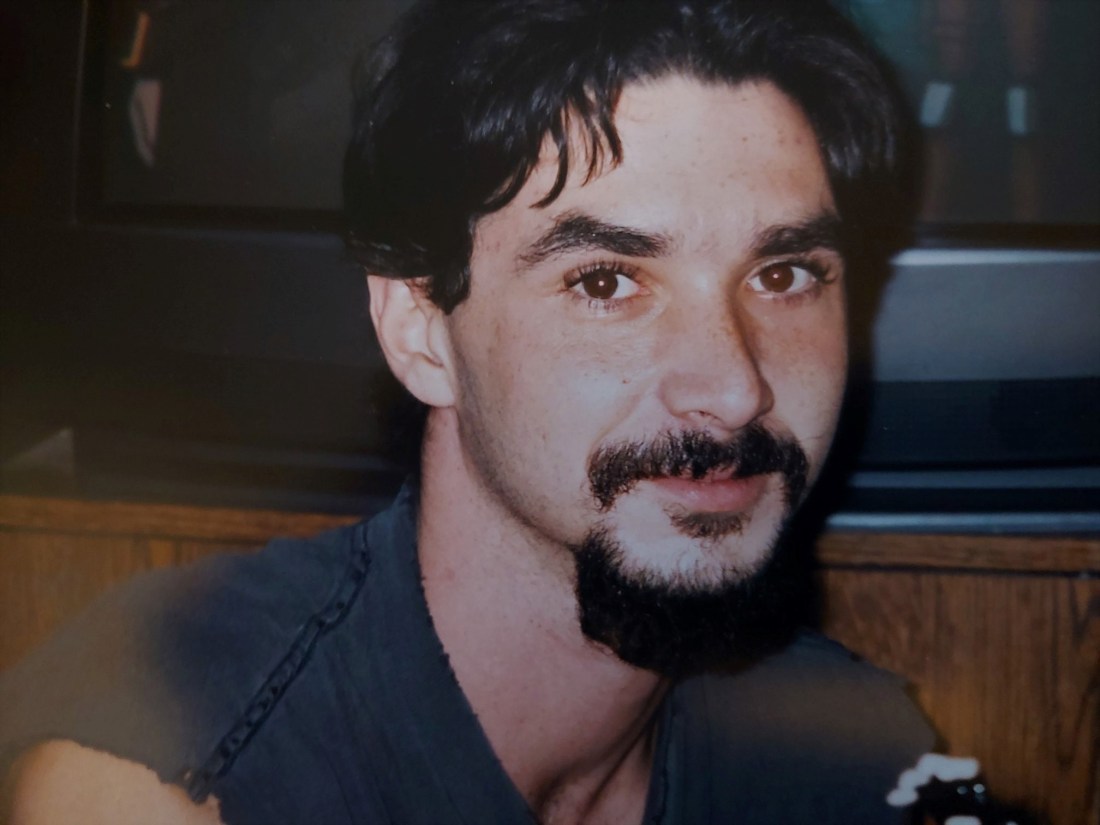
I had been expecting the phone call for a while and I wasn’t entirely sure when I would get it. Last week it came. 327 days after my brother passed away his final autopsy report was ready and the medical examiner was calling me with the results. Even though I knew I would be getting this call at some point it still threw me for a bit of a loop when I got it. Memories came back and from out of nowhere a flood of emotions was washing over me. I quickly gained my composure and steeled myself for what I was about to hear, even though I already knew what the results would be.
There were no surprises. Ryan died as a result of multi drug toxicity, the manner of death accidental. Among the drugs in his system when he died were alcohol, methamphetamine, heroin, oxycodone, morphine, and codeine, but the one that killed him was fentanyl. He had five times the therapeutic level of fentanyl in his blood when he died. If nothing else I can take solace in the fact that my brother didn’t suffer at the end, he drifted off to sleep and died peacefully.
Ryan had been an addict for years before he died and he never denied it. He used to say “drugs do me” every once in a while and he wasn’t shy about his drug use either and had told me on many occasions that he figured he had done pretty much all the drugs. The exception to this at the time however being heroin and fentanyl. He told me once that he found no appeal in a drug that makes you puke your guts out the first time you use it. That and the fact that he didn’t like needles kept him away from heroin. That and the addictive potential that it had. He may have been an addict but being a heroin addict is on a much different and far scarier plane. It was the same with fentanyl for him.
Things had changed in the last year of his life though and he found himself spiraling down into a deep and dark place. He found himself living in a camper behind a house with the lowlife who would be his conduit to the poison that killed him. He knew the risks, but it was a very cold winter and he would do anything to feel warm. Relieving his physical and mental pain was simply an added bonus. It wasn’t long at all before he required it on a regular, daily basis otherwise he would be wracked with the physical agony of withdrawal.
I’m quite sure that at some point in his life somebody told Ryan that if he continued on the path that he was on that he would wind up being a statistic. In fact it’s something that every addict has heard at least once in their lives. I’m not sure how Ryan felt about that but the fact of the matter is that he is now a statistic, a number on an ever alarming tally sheet.
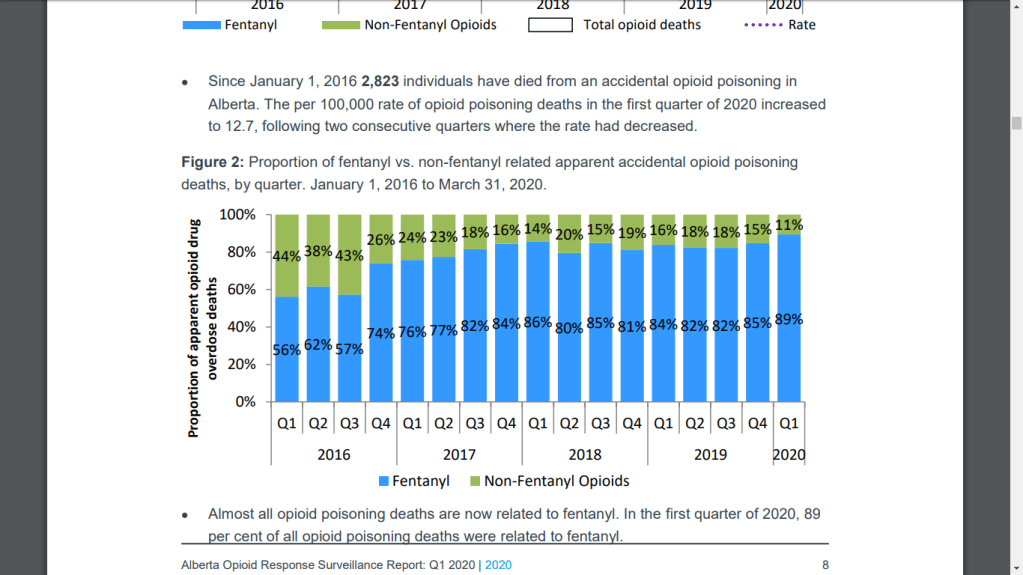
According to the Alberta Opioid Response Surveillance Report released by the provincial goverment and the Office of the Medical Examiner, Ryan was one of 49 individuals to accidentally overdose on fentanyl in Calgary in the third quarter of 2019. There were a total of 211 in Calgary for the year. In the first quarter of 2020 there were another 49. In fact from Q1 2016 to Q1 2020 a total of 983 people died from accidentally overdosing on fentanyl, the most of any zone in the province and ahead of Edmonton where there were 700 such deaths reported.
What is alarming is the increase in the number of accidental overdoses of fentanyl from 2016 until the present. Of all accidental opioid overdose deaths in Alberta a staggering 89% are attributed to fentanyl. That is up considerably from 2016 when it began the year at 56%. I’ve sent an email to the Office of the Chief Medical Examiner to see if anyone would be able to provide me with an explaination for the big increase in Q4 over Q3 of that year. It is from this point that the number has been steadily increasing until the present day. I will provide updates as further information becomes available.
Welcome to the opioid crisis, which began in the 1990’s when Purdue Pharmaceuticals unleashed OxyContin onto an unwitting public. Falsely claimed to be non-addictive, the powerful narcotic was prescribed by doctors in large numbers. The results have proven to be tragic and incalculable. It has spawned an explosion in the number of prescription drug addictions and redically changed the demographics of addiction within a generation. Previously addicts became addicted after using ilicit drugs whereas now a large number of opioid addicts became addicted after using prescription narcotics like OxyContin. Todays drug addicts are housewives, business owners, school teachers and your next door neighbour, with no shortage of pro sports figures falling in these ranks as well.
Now fentanyl is prevalent, creating addicts in ever increasing numbers and killing indiscriminantly. Drug dealers stand to make huge profits from it and don’t seem to care that their business model is one that is killing off their customers. For them there will always be another addict to bleed, and another one after that. More and more, people are chasing the fentanyl dragon creating more and more work for medical examiners.
What’s heartbreaking to me is that Ryan had been talking to one of his closest friends about trying to find a rehab facility, and they were supposed to get together the following day. Ryan passed away later that night. If the heroin he got hadn’t been so laced with fentanyl he might have been able to find the help he so desperately needed, but it robbed him of that opportunity and us of Ryan.
My brother was by no means perfect but that didn’t make him a bad person. He would have his moods and could to get angry from time to time he was in his heart a good and gentle man. Softspoken, he had a kind soul and was the best and most loyal friend a person could hope to have, there for you should you need him. This still came through despite the battle he was waging against his inner demons. This is who I will remember and how he should be remembered, rather than for his faults or the way he left us.
For those of us that loved him it was hard to see him in so much mental and emotional pain and anguish, so yes there is the solace that comes with knowing that your loved one is no longer suffering. I however am looking at it slightly differently, in that it’s a good thing that he isn’t around to have to experience what the rest of us have had to since the beginning of this year. I know that he would have absolutely HATED being in lockdown and I really don’t know how he would have handled it, and given the current state of things and the direction they appear to be going in, it might be fair to say that he’s a lot better off than we are.
I will forever carry the burden that is carried by many who have lost a younger sibling. There is a feeling of guilt that goes along with it, survivors guilt perhaps, telling you that this isn’t how it’s supposed to work. The oldest is supposed to go first. Add to the that the feeling that you have broken what almost seems like a law of nature in that the older sibling is supposed to look out for the younger one(s). It would almost seem like a cop out to simply say I that I am not my brother’s keeper, but that’s the reality that I am coming to grips with.
I realize that his death, while significant to those that loved him, won’t have an impact on the opioid crisis we now find ourselves in. I hope and pray however that it might make enough of a difference to save someone’s life down the road, that way he will not have died in vain. I know this is what my brother would have wanted, and it’s what I will work towards while I am still here on this Earth.
I miss you so much little brother, we all do, and I look forward to the day when we see each other again. I love you buddy.
A demonstration of the important link between nutrition and living with a brain injury.
I have written about the importance of diet and nutrition when it comes to living with a brain injury. Eating the proper diet can make the world of difference if you have a brain injury and veteran Dave Bona is a prime example. Dave has posted many Facebook videos on the subject and can tell you first hand what it’s all about.
Dave has chronic quinoline encephalopathy after taking the antimalarial drug mefloquine, also known as Lariam. It is neurotoxic, and has destroyed cells in Dave’s brainstem leaving microscopic holes in it. This interferes with some of the signals that are going to his brain via his central nervous system and as a result he suffers from a myriad of debilitating symptoms. Among these are what are known as “mefloquine rages”. These are pretty much what they sound like and Dave describes the experience quite well on the video.
So what triggered it? He was out running some errands with his daughter who decided to buy herself a bag of saltwater taffy. Like most of us probably would he asked her for some and she gave him three pieces, which he enjoyed. About twenty minutes later he could feel it coming on and he knew something wasn’t right. Dave, usually ever vigilant, didn’t read the ingredients before consuming the taffy and missed seeing the sugars and artificial colors that were in it.
Lesson learned for Dave and he’s sharing it so that everyone else will know about it too.
Candidly sharing his own decades long struggle with Depression from Quinism, Dave addresses some of the side effects such as rages/seizures, impotence and more all caused from Quinism and all contributing factors to the cycle of Depression.











 The Advocate-Equalizer
